Christmas Presents for the Kid Who Has Everything
The kid with everything is bored by category, not quantity. What lands: experiences, things with their name on them, and being the main character.
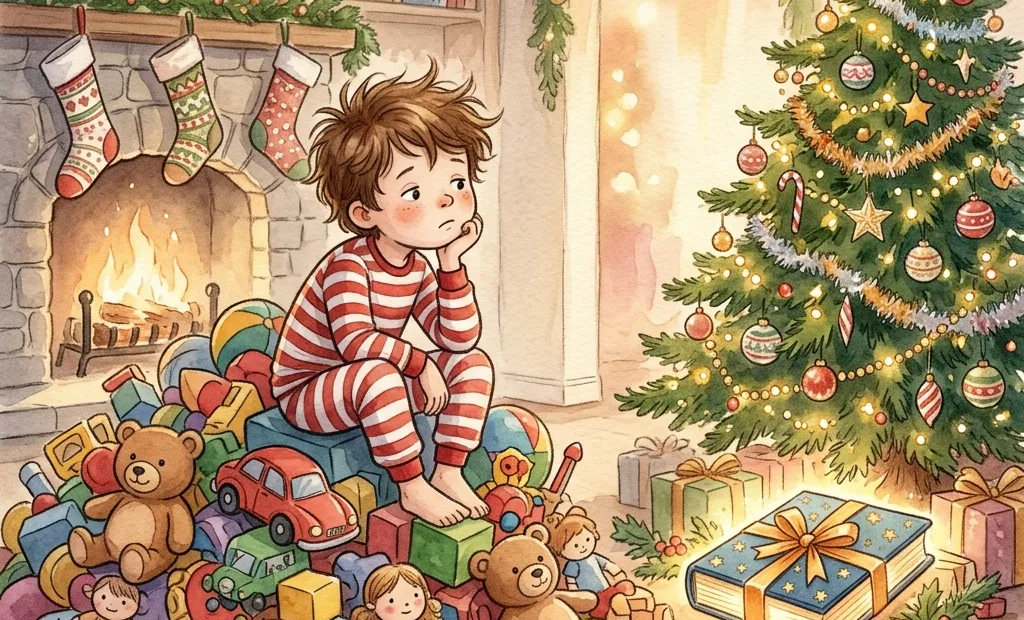
Every family has one — the kid whose room is already full, whose grandparents already got there first, whose parents have stopped writing wish lists because the honest answer is I don’t know, he has most of it already.
The instinct is to solve this with more searching. A better toy, a rarer toy, a toy from the shop nobody else thought of. That instinct is wrong, and it is worth saying plainly why.
The problem is category, not quantity
A child who has plenty of toys is not bored because the pile is too small. They are bored because everything in the pile is the same kind of thing. Another action figure enters a room that already has forty action figures, and it does not register as a new experience. It registers as more of an existing one.
What actually cuts through is not a better version of what they already have. It is something that is not a version of anything they already have — a different category entirely. Once you accept that, the shopping gets much easier, because you stop competing with their existing pile and start ignoring it.
What actually lands
An experience with a real date attached. Not a gift card to an experience — an actual booked thing, written on a card: the trampoline park on January 3rd, the go-kart track the Saturday after New Year’s. A ticket is not competing with the toy pile because it is not an object at all. It is something to look forward to, which a full room of toys cannot manufacture no matter how large it gets.
A skill lesson, not a skill kit. The difference between a beginner’s guitar under the tree and six weeks of actual lessons is enormous, and it is entirely in the follow-through. A kit gets tried twice and shelved. A standing Tuesday lesson with a real teacher becomes a thing the child does, which is a different kind of gift than a thing the child owns.
A membership that renews attention all year. A year at the climbing gym, a museum family pass, a season of a sport they have been asking about. This spends once and pays out fifty-two times, and unlike a toy, it cannot be outgrown by February — if anything it gets more used as the year goes on.
Something with their actual name on it, permanently. Custom is not the same as personalized-in-the-loose-marketing-sense. A monogrammed backpack, initials on a real leather wallet if they are old enough to carry one, a name stitched into something they will use daily. The point is that it cannot be regifted, resold, or handed down, because it says who it belongs to.
A responsibility, dressed as a gift. A pet-adjacent role — feeding the neighbor’s fish while they travel, a chore chart that pays out to something they are saving for, a small garden bed that is theirs to run. Nine- and ten-year-olds in particular respond to being trusted with something real more than they respond to being given something else.
A collaboration, not a purchase. A cooking class for the two of you together, a pottery session, a single afternoon doing the thing they are into with the adult who bought the gift standing right there. This works because it spends your time, which is the one resource nobody else in the family has already given them this year.
Being the main character of something, for once. More on this below — it is the category none of the above quite covers, and it is the one we build.
The one thing that cannot be duplicated by definition
Here is the actual insight behind “the kid who has everything”: everything they have is a copy of something. The toy exists in a warehouse in multiples. The game console exists in millions of living rooms. Even the experience, wonderful as it is, could in theory be booked by anyone.
A book where your specific child is the illustrated hero of their own story cannot be that. It is not rare because it is expensive or hard to find — it is rare because it is structurally impossible for anyone else to own the same one. There is exactly one book in the world with that child’s face and name in it, and it exists because someone made it for them specifically.
That is a genuinely different category from “another toy,” which is why it tends to work precisely on the kid who has run out of things to want.
The book, in specifics
Akoni Books makes a 16-page personalized storybook where one child is the illustrated hero — their face and their name woven through the entire story and every single illustration, not a name dropped onto page three of an otherwise generic book. You choose from nine art styles, the story fits every kind of family, and it comes with a 19-page printable Hero Pack of activity sheets built around the same character.
The dedication page is what turns it from a product into a gift. During creation there is a field marked “Who’s this book from?”, and whatever you type there prints on the first page:
For Theo, with love.
From Mom and Dad
It appears in the digital edition, the printed edition, and the free preview, so you can check it before paying for anything.
What you need: the child’s first name, their age, and one clear front-facing photo.
What it costs: $9.99 for the digital edition, $39.99 for a hardcover. A second language — Spanish, French, Portuguese or Mandarin Chinese alongside English, on every page — is $10 more on any format.
How the pictures are made: they are AI-generated, using the uploaded photo as a visual reference, and rendered in the art style you choose — a stylized illustration, not a photograph, not a human-commissioned drawing. You see the illustrated cover, the signed dedication and the opening pages free, before paying anything, so you can judge the likeness yourself first.
If it does not land: a full refund if the child does not light up when they see themselves on the cover, and they keep the book regardless.
For more gifts that survive past Boxing Day, see nine Christmas gifts for grandkids that aren’t toys — the same logic about category over quantity applies whether you are the parent or the grandparent doing the buying.
Do not overthink the wrapping
None of this needs to be an elaborate production. The kid who has everything does not need eleven perfect presents — they need one or two things that are not just more of what they already have. A booked experience, a lesson that keeps going, a name stitched into leather, or a story where they are finally the one it is about. Pick two, skip the rest of the search, and stop trying to out-shop a room that is already full.
If a hardcover is part of the plan, printed books are made to order and need lead time — see the full order-by dates guide for exactly when to order by.