Kwanzaa Gifts for Kids: Principles That Fit in a Book
Kwanzaa’s traditional gifts are a book and a heritage symbol, given to kids. How to give both, seven small ideas for the seven principles, and the dates.
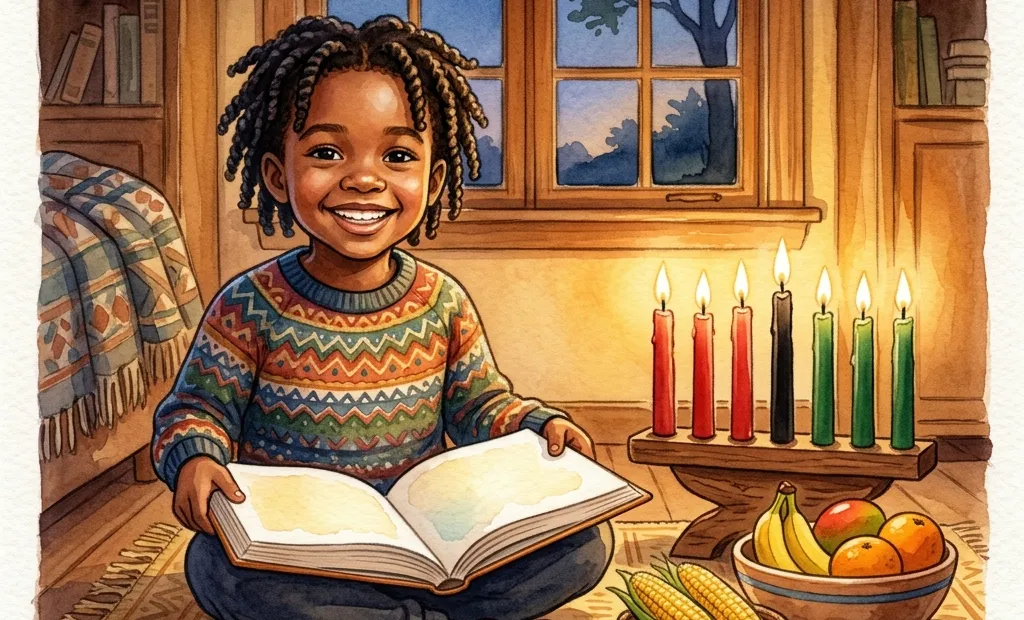
Most Kwanzaa gift guides are a list of things with red, black and green on them: a sweatshirt, a coloring book, a flag. Nothing wrong with any of it. But it skips what the holiday itself says about gifts, and what it says is more specific, and easier to shop for, than the lists suggest.
What Kwanzaa actually asks for
Kwanzaa was created in 1966 by Maulana Karenga as a specifically African American holiday. It runs December 26 through January 1, with one of seven principles, the Nguzo Saba, assigned to each day: Umoja (unity), Kujichagulia (self-determination), Ujima (collective work and responsibility), Ujamaa (cooperative economics), Nia (purpose), Kuumba (creativity) and Imani (faith). Plenty of families celebrate it alongside Christmas rather than instead of it, and nobody is doing that wrong.
The gifts are called zawadi, and the tradition is unusually clear about them. The core zawadi are two things: a book, honoring learning, and a heritage symbol, honoring history. They go mainly to children, toward the end of the week, as recognition for commitments the child made and kept. Handmade is prized over store-bought. And the gifts are never meant to stand in for a parent’s time and attention.
Read that as a shopper. It is not “find seven gifts.” It is one book, one symbol, and a built-in reason not to build a pile. If you are already dreading the Christmas pile, that is a relief.
The heritage symbol: not the part we make
Be clear on this half first, because a personalized book is not a heritage symbol and we would rather say so than blur it. Traditional guidance is broad: an African art object, a piece of cloth, a picture of a hero or heroine (Fannie Lou Hamer, Mary McLeod Bethune and W.E.B. Du Bois are commonly named), or any appropriate representation of the family’s history and culture.
Our opinion: the best heritage symbol is the one only your family has. A framed photo of a great-grandparent, with a few lines on the back about who they were. A child can hold that in a way they cannot hold a museum-shop object, and it costs less than the sweatshirt.
The book: two kinds, and the best gift stacks both
A book that teaches the holiday or the history. For a child new to Kwanzaa, a story built around the seven principles does the explaining so you do not have to. Seven Spools of Thread by Angela Shelf Medearis is a long-standing choice for early readers, and My First Kwanzaa by Karen Katz suits toddlers. Ask a librarian or a Black-owned bookstore for what is new. That is the “learning” half, and it should come from someone who knows the material.
A book about the child. This is the one that connects to the principles in a way a generic title cannot. Kujichagulia asks a child to define and speak for themselves. Imani asks for faith in oneself. Nia asks for a purpose. A story where the child is the hero at the center of every page is the physical version of being told you are the main character here, which matters most for a child who rarely finds themselves in the picture-book aisle. (We wrote more on why in why every Black child deserves a book where they are the hero.)
Seven small ideas, one per principle
You do not need to buy any of these. Most cost nothing but attention, which is the point.
| Day | Principle | A small version |
|---|---|---|
| Dec 26 | Umoja | Put one photo from every branch of the family on one wall, and let the child say who is who |
| Dec 27 | Kujichagulia | Let the child plan one meal and explain their choices |
| Dec 28 | Ujima | One job the whole household does together: baking, tidying, sorting toys to donate |
| Dec 29 | Ujamaa | Spend a few dollars at a Black-owned business and let the child hand over the money |
| Dec 30 | Nia | The child names one goal for the new year and writes or dictates it in a notebook |
| Dec 31 | Kuumba | Make something by hand together, however rough |
| Jan 1 | Imani | An elder writes the child a letter: what they believe about who this child is becoming |
That last one is the best gift on the list, and the book and the heritage symbol arrive alongside it.
The book about your child: what we make, and what we don’t
Akoni Books makes a personalized storybook in which one child is the illustrated hero, generated from a single uploaded photo. You choose one of nine art styles and one of nineteen story themes, and the hero is rendered from your child’s own photo rather than picked from a menu of preset hair and skin options. The finished PDF is 35 pages: a 16-page illustrated story plus a 19-page printable Hero Pack of activity and keepsake pages.
Now the honest limits:
- There is no Kwanzaa theme. None of the nineteen is a Kwanzaa story. The nearest fits are helper (a natural partner for Ujima), grandparent love if it is a grandparent giving, and name story, whose arc is shaped by what the child’s name means, which rhymes with Kujichagulia’s call to name ourselves.
- If you want a principle in the story, the deeper-customization option lets you specify a lesson to teach, so “Kuumba, making things and leaving a place more beautiful” is something you can ask for. That path is fully bespoke and takes a little longer than a standard book. Digital is still ready in minutes.
- No Swahili. A bilingual edition prints a second language alongside English, but the four options are Spanish, French, Portuguese and Mandarin Chinese, and nothing else.
- The illustrations are AI-generated, stylized renderings from the photo in the art style you choose. They are not photographs or hand-drawn art, and they may not perfectly replicate a child’s appearance. That is why the free preview exists: you see the illustrated cover and the opening pages before paying anything.
The dedication is the part that fits zawadi best. During creation you are asked who the book is from, and a signed dedication page prints inside the book (it shows in the free preview too, so you can proofread it). A line that echoes the tradition:
For Amara, who keeps her promises.
From Grandma, Kwanzaa 2026
What it costs: $9.99 for the digital PDF, $29.99 for an 8×8” softcover, $39.99 for an 8×8” hardcover. Shipping is included in both print prices, and every print order includes the PDF. A bilingual edition is $10 more at any tier. If it does not land: email within 30 days of delivery for a full refund, and the child keeps the book. The uploaded photo is deleted within 24 hours and never used to train AI models.
The dates
Kwanzaa begins Saturday, December 26. These come straight from our December holiday order-by guide, which shows the arithmetic:
| Date | |
|---|---|
| Printed book, safe order-by | Wednesday, December 9 |
| Printed book, last chance | Monday, December 14 |
| Digital | Instant, any day, including the day you give it |
If you plan to give zawadi at the end of the week, you have a few extra days of slack, but December carriers are December carriers, so use the ninth. If you miss it, buy the digital edition to give on the day and order the print copy afterward as a quieter second gift.
If your family doesn’t celebrate
If you are the grandparent, aunt or friend of a family that observes Kwanzaa and you do not, follow their lead. Ask the parents what they are doing and whether a book fits. A book chosen with them beats an armload of Kwanzaa-branded items chosen without. For planning across all the December holidays, our Christmas gifts that aren’t toys list works for any of them.
Related reading
- Hanukkah, Christmas, Kwanzaa: order-by dates for every December holiday →
- How to talk to your Black child about history through bedtime stories →
- Juneteenth for kids: books, activities, and a story starring yours →
- Stocking stuffers fade by January: give one keepsake instead →
- Personalized Christmas gifts: 2026 order-by dates →
Kwanzaa asks for a book, a heritage symbol, and your presence. Only the first two can be bought, and the third matters most. If the book can be one where your child is the hero, make a free preview at Akoni Books → and see them on the cover before you decide.