How to Explain Lunar New Year to Toddlers and Preschoolers (Plus a Storybook Starring Them)
Simple, accurate ways to explain Lunar New Year to kids ages 2 to 5, one custom at a time, with hands-on activities and a storybook where your child is the hero.
A two-year-old doesn’t need the history of the lunar calendar. They need one thing they can do with their hands, one word they can say, and one thing to look forward to. Lunar New Year happens to be full of all three, which makes it one of the easiest holidays to share with very young children.
This guide breaks the holiday into the customs Chinese and Vietnamese families share, with a one-line explanation a toddler can follow, a slightly longer one for a curious four-year-old, and an activity for each.
Start with the big idea
For under-fives, the whole holiday fits in one sentence:
“It’s a new year, so we get the house ready, we wear something new, and we celebrate with the whole family.”
Everything else is detail. Come back to that sentence whenever a question gets too big.
For older preschoolers, you can add: “Lots of families follow a calendar that uses the moon. On that calendar, the new year starts in late January or February. This time it’s on February 6.”
The customs, one at a time
Sweeping out the old year
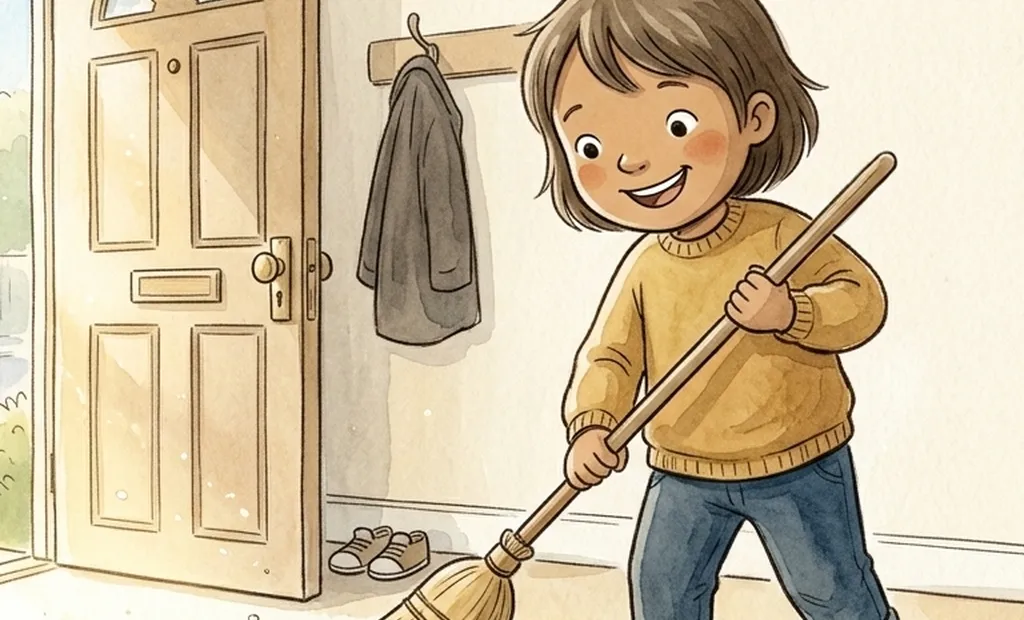
For a toddler: “We sweep out the old dust so the new year can come in clean.”
For a four-year-old: Before the new year, families clean the whole house to sweep away the old year’s bad luck. Many families then don’t sweep on New Year’s Day itself, so they don’t sweep the new good luck right back out.
Try it: Give them a small broom or a dustpan and brush and let them “help” with one room. Toddlers take this job very seriously.
Red everywhere
For a toddler: “Red is the lucky colour. We hang red lanterns and wear red.”
For a four-year-old: There’s an old story about a monster called Nian who came at the new year and was scared away by the colour red and loud noises. That’s one reason families hang red decorations and set off firecrackers.
Try it: Go on a “red hunt” around the house. Collect five red things and line them up. Then make a paper lantern: fold a sheet of red paper in half, cut slits from the fold, open it, roll it into a tube and staple a handle on top.
Blossoms and mandarin oranges
For a toddler: “Flowers mean spring is coming. Oranges mean good luck.”
For a four-year-old: Families bring in branches of blossom for the new season. Many Chinese families use plum blossom; in Vietnam, peach blossom is popular in the north and yellow apricot blossom in the south. Mandarin oranges are everywhere because in Chinese, the word for them sounds like the word for luck, and their golden colour looks like gold.
Try it: Stack mandarins into a little pyramid on a plate. It’s a great fine-motor job for two- and three-year-olds, and they can eat the ones that roll off.
The big New Year’s Eve dinner
For a toddler: “Tonight everybody eats together at one big table.”
For a four-year-old: On the last night of the old year, families gather for a reunion dinner. People travel a long way to be home for it. Some dishes are chosen because their names sound lucky. Fish is a common one, and many families in northern China make dumplings.
Try it: Let them do one real job: set out the chopsticks, carry the napkins, or fold a dumpling (badly, which is fine). Teach them a polite custom many families keep, like serving the oldest person first.
A New Year wish for the grandparents
For a toddler: “On New Year’s morning we say a wish to Grandma and Grandpa.”
For a four-year-old: Children greet their elders with a New Year wish, like “Happy New Year! Good health!” In Mandarin, a simple one is Xīnnián kuàilè (新年快乐). In Vietnamese, Chúc mừng năm mới.
Try it: Practise the wish in the days before. Practise it on the cat, the teddy bear, the mirror. Preschoolers love a performance, and the payoff on the day is real.
The red envelope
For a toddler: “Grandma gives you a red envelope for luck. We say thank you with two hands.”
For a four-year-old: Elders give children red envelopes with money inside for a lucky new year. You take it with both hands, say thank you, and don’t open it in front of the person who gave it to you.
Try it: Role-play with an empty envelope. Take turns being the grandparent. Our post on red envelope gift ideas for kids → has ideas for what to put in a toddler’s envelope.
The lion dance
For a toddler: “A big lion dances to the drums to bring good luck.”
For a four-year-old: Two dancers inside a lion costume move to drums, cymbals and gongs. The lion visits shops and homes to bring luck for the new year. It’s loud on purpose.
Try it: Make a lion from a cardboard box with tissue-paper “fur”, and bang a pot with a wooden spoon for the drum. If there’s a parade near you, go. Stand back a little if your child is sensitive to noise; the drums can be startling up close.
A week of small things for ages 2 to 5
If you want a simple plan, spread the customs out:
- Day 1: Read a picture book about the new year.
- Day 2: Sweep and tidy together.
- Day 3: Red hunt and paper lanterns.
- Day 4: Stack mandarins and put blossoms in a vase (real or paper).
- Day 5: Practise the New Year wish.
- New Year’s Eve: One real job at dinner.
- New Year’s Day: Say the wish, receive the envelope, find a lion dance.
One thing a day is plenty. The goal is that next year, they remember.
Books that help
Picture books do a lot of the explaining for you. Bringing in the New Year by Grace Lin follows a family getting ready, and it is short enough for toddlers. A New Year’s Reunion by Yu Li-Qiong is a gentle story about a father coming home for the new year, better for four- and five-year-olds. Our Lunar New Year books for kids → list goes age by age.
A storybook where they’re the one doing it all
Young children understand stories best when they’re in them. Akoni Books has a Lunar New Year storybook where your child is the illustrated hero, drawn from one photo. On the pages they sweep out the old year, hang red lanterns, arrange blossoms and mandarin oranges, sit down to the big New Year’s Eve dinner, give their morning wish to Grandma and Grandpa, receive a red envelope, and meet a lion dance. It shows the customs Chinese and Vietnamese families share, which makes it a natural way to walk a preschooler through the whole holiday.
It comes in English, or in English and Mandarin Chinese (Simplified) for $10 more. Prices are $29.99 softcover and $39.99 hardcover, each including the digital copy free, with free US shipping. You see the cover and opening pages free before paying, and the photo is used only to illustrate the book and deleted within 24 hours.
Lunar New Year 2027 is Saturday, February 6. For a printed copy, order by Friday, January 22. The digital copy that comes free with every printed book is ready in minutes.
Make their Lunar New Year storybook, free preview →
Keep it small, keep it yearly
You don’t have to teach a toddler everything this year. One custom they did with their own hands is worth more than ten they were told about. Add a little more each year, and by the time they’re six, they’ll be the one explaining it to you.