20 Things to Write in a Child's Christmas Book
The book gets read a hundred times and then shelved. The line you wrote inside it is the part they find again at twenty-two. Twenty inscriptions that work, sorted by who you are to the child — plus the two rules that separate a good one from a blank page.
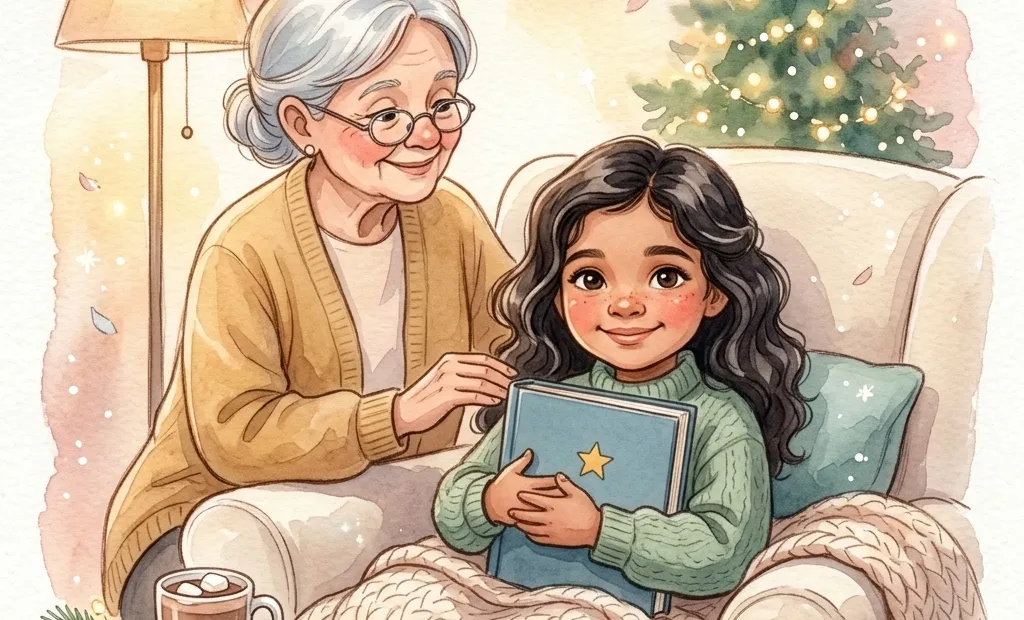
The book is wrapped. The pen is in your hand. You have opened the front cover and you are now staring at a completely blank page, and the only sentence that will come is Merry Christmas, love Grandma, which you know is not enough and cannot think of a way past.
This happens to nearly everybody, and it is worth understanding why before we get to the twenty lines.
Why the inscription is the part that lasts
A children’s book has two lifespans. The first is short and intense: it gets read every night for four months and then it stops. The second begins about fifteen years later, when somebody clears out a shelf, opens the front cover, and finds handwriting.
The story does not survive that gap. The handwriting does. It is the only part of the object that could not have come from anywhere else.
There is decent research behind the instinct, too. Marketing researchers Fuchs, Schreier and van Osselaer, writing in the Journal of Marketing, documented what they called the “handmade effect” — people value objects more when they perceive them to contain love, and, crucially, the effect is strongest when the object is being bought for somebody the buyer actually loves. A mass-produced book with four sentences of your handwriting in it is, to the person receiving it, a partly handmade object.
Which is a research-flavoured way of saying: the four sentences are the gift. The book is the container.
Five rules that make it easier
1. Date it. Month and year is enough. Christmas 2026. This is the single most-skipped and most-regretted omission, and it costs you four characters. Without the date the inscription is nice. With it, it is a record.
2. Sign it the way they call you. Not your name. Nana. Grandad. Auntie Ama. Tio. In twenty years, “with love from Margaret” will require a family conversation to decode, and “Nana” will not.
3. Say exactly one specific thing. One detail that could only apply to this child: the thing they say, the thing they are frightened of, the thing they are currently obsessed with. Specific beats warm. “For the boy who asks ‘but why’ eleven times a night” does more work than three sentences of general affection.
4. Do not give instructions. Work hard, be kind, always believe in yourself. Children absorb instructions from every adult they meet; an inscription is one of very few places where somebody simply tells them what they are already like. Describe, do not advise.
5. Short is completely fine, and use a pen. Two lines in ink beats a paragraph you agonised over. Pencil fades. Ink is the point.
The twenty
Steal them outright, or use them as a shape and swap in your own detail. Names are placeholders.
If you are the grandparent
- “For Maya, who has been my favourite person since the day I met her. Christmas 2026. Love, Grandma.”
- “I have wanted to read this one to you since before you could sit up. Merry Christmas, my love. — Grandpa”
- “You are the fourth generation of this family to have that hair and that temper. Both are excellent. Christmas 2026, Nana.”
- “Every time you laugh, I hear your mother at five years old. Merry Christmas. Love, Grandma.”
- “So that one day, when I am not here to say it: I thought you were remarkable from the very beginning. Christmas 2026. Grandad.”
If you are the parent
- “For the boy who asks ‘but why’ eleven times a night. Never stop. Christmas 2026. Mum and Dad.”
- “This is the year you learned to read. We will never forget it, and neither should you. Merry Christmas.”
- “You are the best thing we ever did. Christmas 2026.”
If you are the aunt, uncle or godparent
- “From your Auntie, who has known you your whole life and intends to be there for the rest of it. Merry Christmas, Amara.”
- “I chose to be your godmother, and I would choose it again. Christmas 2026.”
- “Your dad and I were exactly like this at your age. Ask him about the shed. Merry Christmas — Uncle Kofi.”
If they are too small to read it yet
- “You are two, and this is going to be read to you roughly four hundred times. That is the plan. Christmas 2026.”
- “One day you will read this to yourself, and I will be sitting next to you pretending not to cry. Love, Grandma.”
- “For Isaac. First Christmas, second tooth. From Nana, with love.”
If you live a long way away
- “I am seven hours away and I still know exactly how you sound when you are excited. Merry Christmas, from Grandma.”
- “Read this one at bedtime and I will be in the room, more or less. Christmas 2026. Love, Grandpa.”
- “Distance is a detail. Merry Christmas, my darling. — Nana”
If it has been a hard year
- “This was a big year, and you were braver in it than most grown-ups manage. Christmas 2026. Love, Mum.”
- “Some years you just get through, and getting through is enough. Proud of you. Merry Christmas. Dad.”
- “New house, new school, same you — and the same you is the good part. Christmas 2026. Love, Auntie.”
Where the writing actually goes
If you are inscribing an ordinary shop-bought book, you have one surface: the flyleaf inside the front cover. Write there, in pen, and you are done.
If the book is one of ours, there are two places, and they want different things from you.
The dedication page is typed, and it is the first page of the book. During creation there is a field marked “Who’s this book from?” Whatever you type there prints as:
For Maya, with love.
From Grandma
That field takes up to 60 characters, so it holds a signature rather than a paragraph — but 60 characters is more than it sounds. “Nana, Christmas 2026” fits. So does “Grandma and Grandpa Adeyemi”, and so does “Auntie Ama, who chose you”. It prints in the digital edition, in the printed edition, and in the free preview, which means you can read it back and check the spelling of a grandchild’s name before you have paid for anything.
The bookplate page is blank, and it is for your handwriting. Printed copies carry a page near the front with to, from, date and location lines left open. That is where the twenty above belong — written in ink, in your own hand, which is the version that matters in fifteen years. The from line arrives pre-filled with the name on the order, so if you would rather write it yourself, just write over or beneath it.
The short lines on this page work in both places. The long ones want the bookplate.
What the book is, briefly
Akoni Books makes an original storybook in which one child is the illustrated hero, generated from a single photograph of them. There is a Christmas Magic 🎄 theme built around generosity — trees, lights, snow, gentle Santa-adjacent magic, no religious specificity — and more than twenty other themes if Christmas is not the angle you want. Ages 2 to 10, nine art styles.
What you need: the child’s first name, their age, one clear front-facing photo. If asking for a photo would ruin the surprise, there is a “Don’t have a photo? Choose a character instead” option; the dedication works identically.
What it costs: $9.99 digital, $29.99 for an 8 × 8 inch softcover, $39.99 for a hardcover. Printed editions include the digital PDF and ship free, to 55 countries. English plus Spanish, French, Portuguese or Mandarin Chinese on every page is $10 more on any format.
How long: minutes — Christmas is one of the pre-built themes. Printed books arrive in 5–7 business days after that — the 2026 order-by dates are here.
How the pictures are made: they are AI-generated, using the uploaded photo as a visual reference. They are stylized artistic renderings in the style you pick — not photographs, and not a human-illustrated commission. You see the cover, the dedication and the opening pages free, before paying, so you judge the likeness yourself. The photo is deleted within 24 hours and is never used to train AI models. The inscription, obviously, is entirely yours — which is rather the point of this whole article.
If it does not land: if the child does not light up when they see themselves in it, email within 30 days of delivery and we refund in full. They keep the book.
One last thing
Write it before you wrap it.
Every year a certain number of people mean to do the inscription on Christmas Eve, run out of evening, and hand over a beautiful book with a blank first page. The book is still good. But the page stays blank forever, because nobody goes back and writes it in March.
Two lines. In pen. Then wrap it.