8 Christmas Gifts for Grandkids Far Away
Being far away is not really a shipping problem. It is that you are not in the room at bedtime. Eight presents that put something of you into a house you cannot get to this Christmas — and how to send them so they arrive signed.
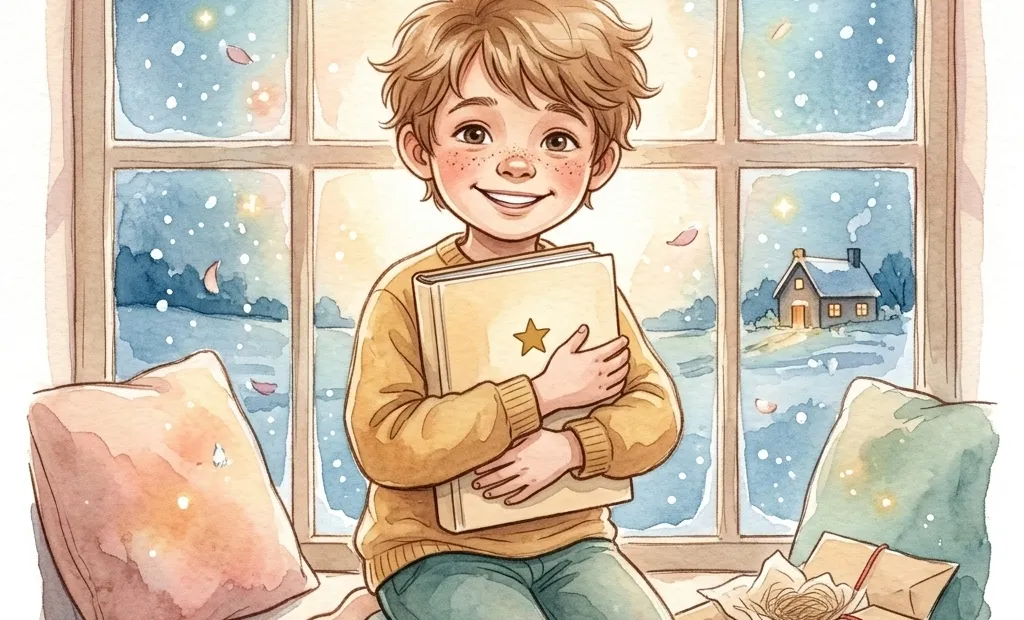
The hardest part of being a long-distance grandparent is not the flights or the time zones. It is a much smaller thing, and anyone in the position will recognise it instantly:
The child is polite to you.
Not cold. Polite. They wave at the screen, they answer the questions, and then they look off-camera because something more real is happening in the room. Familiarity is built out of ordinary repeated contact, and a video call every Sunday is contact but it is not ordinary. You are an event. Events do not accumulate into closeness the way Tuesdays do.
You are not imagining it and you are not alone in it — AARP’s 2026 study of grandparents found that the large majority of long-distance grandparents lean on digital contact to stay close, which is both encouraging and exactly the problem: a screen is where you already are.
So the useful question for December is not what will they like? It is:
What can I put into that house that keeps working when I am not on the screen?
The eight below all answer that. The first is what we make, and there is a full section on it lower down.
1. A book they are the hero of, signed by you
A story in which your grandchild is the illustrated main character, posted to their house, with your name printed on the first page. It gets read at bedtimes you are not present for, by a parent who does not have to explain who it is from, because it says so.
That is the whole mechanism: it is a physical object in their room, in regular use, that carries your name. Full details, prices and timings below.
2. A recording of your voice reading something
This is the highest-value item on the list and it costs nothing but forty minutes and a phone.
Record yourself reading a book — any book, one you already own, one you can post a copy of ahead of time. Read it badly. Do the voices badly. Leave the pauses in, leave the page turns in, leave in the bit where you lose your place.
Send the file to the parents. It goes on at bedtime. Over a few months your voice becomes an ordinary part of the room rather than a Sunday event, and that is precisely the gap the video calls cannot close.
One honest note about ours: every Akoni order includes a bedtime audio version of the story in the Hero Pack, which is genuinely useful — but it is a professional narrator’s voice, not yours. It does a different job. If you want your own voice in the room, record it yourself. It is worth more than anything you can buy.
3. A standing call with an actual activity in it
Same day, same time, every week, and — critically — with something to do.
“How was school” produces nothing from a six-year-old, forever. Reading the same chapter book together, ten minutes at a time, produces a great deal. So does a shared drawing (you both draw the same thing and hold them up), a running joke, or a card game you can both see.
The gift here is the standing appointment, ideally written down and given as part of the parcel: every Sunday at four, you and me.
4. Something that arrives every month
A magazine subscription, a comic, a science-kit box. Twelve deliveries with the child’s own name on the envelope.
For a distant grandparent this is the single best value on the list, because the problem you are solving is frequency, not generosity. One present in December buys you eleven more appearances during the year.
5. A photograph of the two of you, at their height
Not on the mantelpiece. In their room, at their eye level, somewhere they see it without being told to. A small frame on a bedside table, or a print in a bookshelf they can reach.
Ask the parents to place it. Children form attachments to faces they see daily and to almost no faces they do not.
6. The same object in both houses
Two copies of the same book. Two of the same small toy. The same jigsaw. The same mug.
It sounds sentimental and it is unusually practical: it gives you and the child a shared object to talk about on a call, which solves the conversational problem in point 3 without needing an activity to be organised. “I am drinking out of the blue mug. Where is yours?“
7. Post. Actual post, addressed to them personally
A postcard a week with almost nothing on it. It rained. The cat is fine. I saw a dog wearing a coat.
Children receive essentially no post, so anything with their name handwritten on the front is an event. Send a small stack of them in the Christmas parcel too — pre-stamped, pre-addressed back to you — so the child can write to you without an adult having to organise it.
8. A visit, with the date already written down
If you can afford to travel, the present is the flight. Book it, print the date on a card, and put the card in the box.
If you cannot travel, do the reverse: a date, written down, for when they come to you. Six weeks of a child looking forward to something is not a small thing to give.
The book, in specifics
Akoni Books makes an original storybook in which one child is the illustrated hero, generated from a single photograph of them. You pick the theme and one of nine art styles. For December there is a Christmas Magic 🎄 theme built around generosity — trees, lights, snow, gentle Santa-adjacent magic, no religious specificity — for ages 2 to 10.
The part that matters for a gift sent from a distance: during creation there is a field marked “Who’s this book from?”, and whatever you type there prints on the dedication page, the first page of the book:
For Maya, with love.
From Grandma in Kumasi
The field holds 60 characters, so a place fits, and a year fits. It prints in the digital edition, in the printed edition, and in the free preview — so you can read it back before you pay. Printed copies also carry a bookplate page near the front with blank to, from, date and location lines, which is the right place to write something longer in pen, if the parcel is going via you. (Twenty lines that work are here.)
Where it ships: printed books go to whatever address you enter at checkout. You do not need to receive it and forward it — put the grandchild’s address in, and it arrives at their house with your name already inside it. Shipping is free, to 55 countries.
The photo problem, which is worse at a distance. You need one clear front-facing photo of the child, and asking a parent for one in November without explaining why is not subtle. Two ways round it: ask for “a nice recent photo for a frame”, which is true; or use the “Don’t have a photo? Choose a character instead” option, which lets you pick an illustrated character rather than uploading a photograph. The name, the age, the theme and the signed dedication all work exactly the same.
If the grandchild is growing up in a different language from yours, a second language — English plus Spanish, French, Portuguese or Mandarin Chinese, both on every page — is $10 more on any format. For a family where the grandparent’s first language is not the one the child is schooled in, this is often the actual point of the gift rather than an add-on.
What it costs: $9.99 for the digital edition, $29.99 for an 8 × 8 inch softcover, $39.99 for a hardcover. Both printed editions include the digital PDF.
How long it takes: minutes. Christmas is one of the pre-built themes, so the book is ready while you are still at the keyboard. A printed book then arrives in 5–7 business days.
How the pictures are made: they are AI-generated, using the uploaded photo as a visual reference. They are stylized artistic renderings in the art style you choose — not photographs, and not a human-illustrated commission. You see the illustrated cover, the signed dedication and the opening pages free, before paying anything, so you judge the likeness yourself. The photo is deleted within 24 hours and is never used to train AI models.
If it does not land: if the child does not light up when they see themselves in it, email us within 30 days of delivery and we refund you in full — and they keep the book.
If there is more than one grandchild in that house
One child stars per book. Two grandchildren means two books; there is no version where a single book stars both. Siblings notice this in about four seconds, so if you are sending to a house with more than one child, send one each — same theme, same art style, ordered together.
If a genuinely multi-child book is what you need, our comparison of the five main personalized-book companies is honest about who does that better than we do.
Send it earlier than you think
Distance and December are a bad combination, and the deadline is earlier than the one in your head.
For printed books inside the United States, order by Wednesday, December 9, 2026 to be comfortably safe. If the parcel is crossing a border, add a fortnight of margin on top of that and aim for the last week of November — the 5–7 business day window is what we and the carrier control, and a December customs queue is not.
If you miss it entirely, the sequence that works is: buy the digital edition so it can be read on Christmas morning, and order the printed copy afterwards. Every print order includes the digital PDF anyway. A hardback arriving in January is not a late present; it is the record of the Christmas you were not there for, and it will outlast everything else in the parcel.
The full arithmetic is in the 2026 order-by dates post.
Related reading
- 9 Christmas gifts for grandkids that aren’t toys →
- 20 things to write in a child’s Christmas book →
- Personalized Christmas gifts: 2026 order-by dates →
- Three generations, two languages: grandparents and bilingual kids →
- Personalized bedtime audio that stars your child →
- Answer: how does a grandparent give a personalized book as a gift? →