The Bilingual Keepsake: A Personalized Storybook in Two Languages
Most bilingual kids' books are a classic story translated twice. What a two-language family actually needs is their own kid, on the shelf, in both languages.
Search “bilingual children’s books” and most of what comes back is the same handful of titles, translated into a second language — a well-loved story, printed twice, side by side. That is a perfectly fine way to build vocabulary. It is not, in any real sense, a book about your family.
For a household actually raising a child across two languages — a Spanish-speaking abuela, a Mandarin-speaking nǎinai, an English-speaking classroom, a home that code-switches without anyone thinking about it — a translated bestseller is missing the one thing that would make it feel like it belonged to them specifically: their own kid, in both languages, in the same object.
What “bilingual” usually means, and why it falls short
Most bilingual picture books are one of two things: a classic story run through translation, with characters who look like nobody in particular, or a “learn Spanish” style workbook dressed up as a storybook, built to teach vocabulary rather than to be read for pleasure at bedtime.
Both are useful. Neither does the thing a family actually wants from a bilingual keepsake, which is a book that reflects the specific two languages spoken in that specific house, read to a child who can see themselves in it. A generic bilingual book teaches language. It does not hold a family.
One book, both languages, their kid as the hero
The alternative is a book built the other way around: start with the actual child — their name, their face, their age — and print the story they’re the hero of in both of the languages that already exist in their house. Not a generic English/Spanish pairing chosen because it’s the most common one. Whichever second language the family actually speaks.
That distinction matters more than it sounds like it should. A translated classic is the same book every bilingual family on the shelf has. A personalized one, in the family’s own second language, is the only copy that exists with that exact child on the cover.
The abuela reads the Spanish page
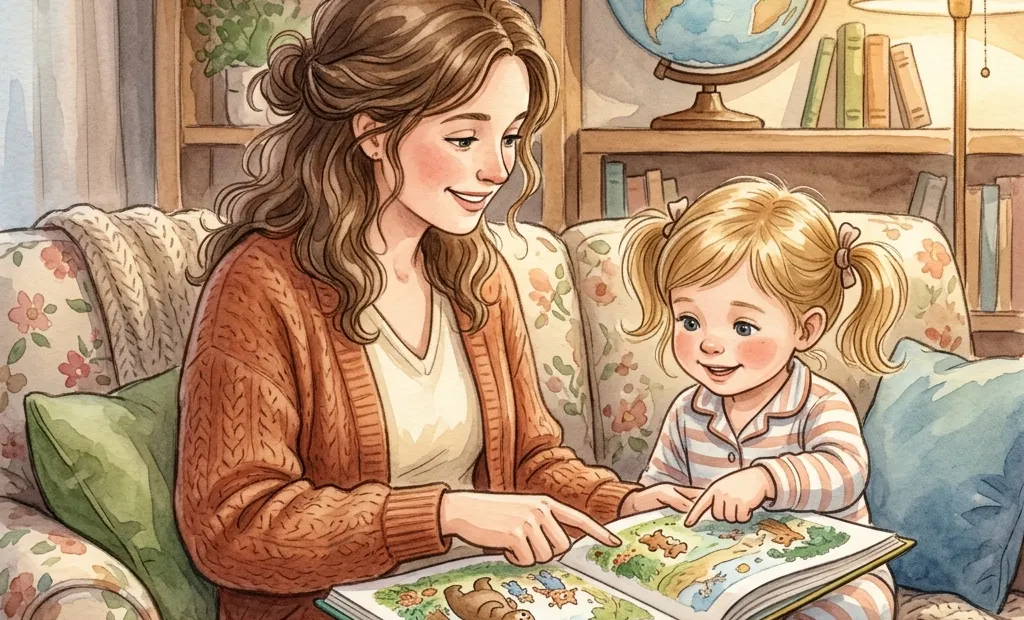
Here is what that looks like in practice. The same physical page carries both languages, printed together — so whichever adult is holding the book that night reads in whichever language is theirs. The abuela reads the Spanish half aloud on a Sunday visit, pointing at the illustration of her own grandchild. A few nights later, a parent reads the English half at bedtime, same page, same picture, same story.
Nothing about the story changes depending on who is reading it or which half of the page they’re reading from. That is the actual point: it becomes one object that belongs equally to both sides of the family, instead of an English shelf and a separate Spanish shelf that never really talk to each other. A grandparent on a video call can read their language over the screen while the child follows along on their own copy — the same trick that works for long-distance grandparents in general →, just doubled, because now the shared object also carries her own language in it.
Why it has to actually get read, not just owned
A bilingual book that sits unopened on a shelf does nothing for a child’s second language, no matter how good the translation is. The research on heritage-language retention is fairly consistent on this point: children hold onto a minority language in rough proportion to how often it is spoken and read to them directly, by a person, out loud — not by how many bilingual books happen to be in the house.
That is the quiet argument for making the book personal. A grandparent is far more likely to pick up and read a book with her own grandchild’s face on the cover than to reach for a generic bilingual title she has already read to three other grandchildren in three other families. The book gets chosen more often because it is not interchangeable with any other book on the shelf, and a language only gets reinforced on the nights it is actually read aloud.
How the bilingual edition actually works, honestly
After choosing the photo, name, age, theme and one of nine art styles, you can add a second language to the order. Akoni prints the same story — the same pages, the same illustrations, the same child as the hero — in English paired with that second language, both on the same pages, rather than producing two separate books. Current second-language options are Spanish, French, Portuguese and Mandarin Chinese.
The dedication page works the same way it does on every Akoni order: a field marked “Who’s this book from?” prints on the first page, in whatever language and words the giver chooses — so a grandparent can sign it entirely in their own language, in their own hand of words, for a book their grandchild will actually be able to read someday on either side of the family:
Para Sofía, con todo mi amor.
De tu Abuela
It appears in the digital edition, the printed edition, and the free preview, so you can check the spelling and the wording before paying anything.
What it costs: digital from $9.99, hardcover $39.99, with the second language as an add-on to any format. A free preview shows the illustrated cover, the dedication and the opening pages before you pay. If the child does not light up at the cover, a full refund — and they keep the book either way.
How the pictures are made: they are AI-generated, using the uploaded photo as a visual reference — stylized artistic renderings in the style you choose, not photographs and not a human-illustrated commission. The photo is deleted within 24 hours and is never used to train AI models.
Who this is actually for
Mixed-heritage families, where the two languages in the house came from two different sides of the family and neither one wants to be the version that gets left out of story time.
Immigrant grandparents whose first language isn’t the one their grandchild is being schooled in — this gives them a book they can read aloud in their own words, rather than translating on the fly from an English-only book.
Adoptive families keeping a birth-language connection alive, where a bilingual keepsake becomes part of how that connection stays present rather than becoming a once-a-year effort.
Long-distance grandparents, for whom the book becomes a shared object across a screen in a language that is actually theirs, not a compromise language chosen for convenience.
Related reading
- How personalized books help kids learn Spanish →
- The best bilingual children’s books in English and Spanish →
- Three generations, two languages: grandparents and bilingual kids →
- Long-distance grandparent gift ideas that shrink the miles →
A translated classic will always be somebody else’s story, printed twice. This one is theirs, in both languages, from the first page. Build it, free to preview →