Long-Distance Grandparent Gift Ideas That Shrink the Miles
Distance is a presence problem, not a shipping one. Seven gifts that put a grandparent inside a grandchild's week, plus a video-call trick worth stealing.
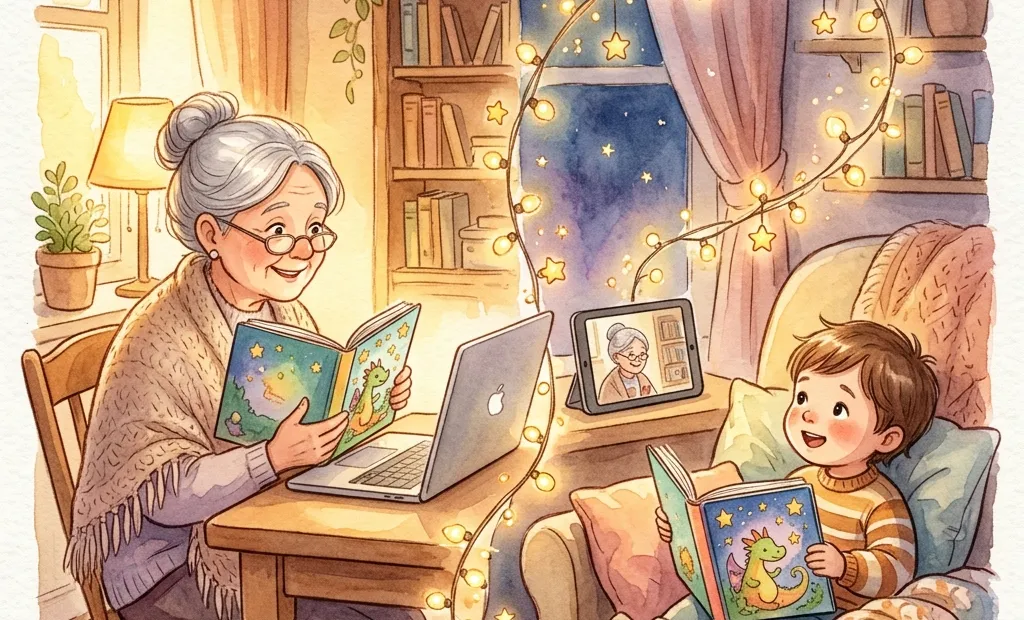
On a video call, a grandchild is polite to you. Not cold — polite. They wave, they answer a question or two, and then they look off-screen, because something more interesting is happening in the actual room they are in. That is not a reflection on how much they love you. It is what happens to familiarity when contact only arrives in scheduled, occasional bursts.
Familiarity is built out of ordinary repeated contact — the stuff of Tuesdays, not the stuff of events. A weekly video call is contact, but it is still an event: dressed up a little, watched a little, gone as soon as it ends. It does not accumulate into closeness the way a bedtime routine does, because it never gets to be boring and normal.
So the useful question when you are shopping for a long-distance grandchild is not what will they like? It is: what can I put into that house that keeps working when I am not on the screen?
Presence is the problem, not the mile count
Everything below answers that question directly. None of it requires you to be in the room. All of it is designed to make you a fixture of the house rather than a scheduled appearance in it.
Gifts that put you inside the ordinary week
A book they are the hero of, signed by you. A story where your grandchild is the illustrated main character, posted to their house, with your name printed on the first page. It gets read at bedtimes you are not present for, by a parent who does not have to explain who it is from, because it already says so. Full details below.
A recording of your own voice reading something. This is the highest-value item on this list and it costs nothing but forty minutes and a phone. Record yourself reading a book you already own — badly, with the voices done badly, pauses left in, page turns left in. Send the file to the parents and let it go on at bedtime. Over a few months your voice becomes an ordinary part of the room instead of a Sunday event, which is precisely the gap a video call cannot close.
A standing weekly call with an actual activity in it. “How was school” produces nothing from a six-year-old, forever. Reading the same chapter book together ten minutes at a time produces a great deal. So does a shared drawing, a running joke, or a card game you can both see on screen. The gift is the standing appointment — same day, same time, every week — ideally written down and handed over as part of the parcel.
Something that arrives addressed to them every month. A magazine subscription, a comic, a science-kit box. For a distant grandparent this is the single best value on the list, because the problem you are solving is frequency, not generosity. One gift in a box buys you twelve appearances across the year.
A photo of the two of you, at their eye level, in their room. Not on the mantelpiece. On a bedside table, or a shelf they can reach without being told to. Ask the parents to place it — children form attachments to faces they see daily and to almost no faces they do not.
The same object in both houses. Two copies of the same book, two of the same small toy, the same mug. It sounds sentimental and it is unusually practical: it gives you and the child a shared object to talk about on a call, which solves the “nothing to talk about” problem without needing an activity to be organized.
Real mail, addressed to them personally. A postcard a week with almost nothing on it. Children receive essentially no post, so anything with their name handwritten on the front is an event. Include a small pre-stamped, pre-addressed stack so the child can write back without an adult having to organize it.
The video-call story trick
Keep a second copy of the same book at your own house — the digital edition is cheap enough that this is barely a cost. On your next call, both of you open to the same page. You read a line, they read a line, or you read the whole thing while they follow along on their own copy across the screen.
Because it is the same book with their own face illustrated into it, this collapses two problems into one solution: it is the shared object from the list above, and it is the actual activity a call needs instead of “how was school.” It also means the book does not just get read to them once and shelved — it becomes the thing you two do together on a schedule, regardless of the miles between you.
The book, in specifics
Akoni Books makes an original storybook in which one child is the illustrated hero, generated from a single photograph of them — their real name and face woven through the story and drawn into every illustration, not printed onto a single page of somebody else’s book. Nine art styles, and every kind of family represented in the theme library.
The part that matters for a gift sent from a distance: during creation there is a field marked “Who’s this book from?”, and whatever you type there prints on the dedication page — the first page of the book:
For Maya, with love.
From Grandma in Kumasi
It prints in the digital edition, the printed edition, and the free preview, so you can read it back and check the spelling before paying anything. Printed copies also carry a bookplate page with blank to, from, date and location lines, which is the right place to write something longer in pen if the parcel is passing through you first.
Where it ships: printed books go to whatever address you enter at checkout. You do not need to receive it and forward it — put the grandchild’s address in, and it arrives at their house with your name already inside it.
The photo problem, which is worse at a distance. You need one clear front-facing photo of the child, and asking a parent for one out of nowhere is not always subtle. Two ways round it: ask for “a nice recent photo for a frame,” which is true, or use the “Don’t have a photo? Choose a character instead” option, which lets you pick an illustrated character rather than uploading one. The name, the age, the theme and the signed dedication all work exactly the same.
If the grandchild is growing up in a different language from yours, a bilingual edition — English paired with a second language, printed together on the same pages — means you can read the book aloud to them, on a call or in a signed inscription, in the language you actually speak at home.
What it costs: digital from $9.99, hardcover $39.99. Both printed editions include the digital PDF, which is what makes the video-call trick nearly free — order one printed copy for the grandchild and keep the digital copy for yourself.
How the pictures are made: they are AI-generated, using the uploaded photo as a visual reference — stylized artistic renderings in the style you choose, not photographs and not a human-illustrated commission. You see the illustrated cover, the signed dedication and the opening pages free, before paying anything, so you can judge the likeness yourself. The photo is deleted within 24 hours and is never used to train AI models.
If it does not land: if the child does not light up when they see themselves in it, a full refund — and they keep the book either way.
If there is more than one grandchild in that house
One child stars per book. Two grandchildren means two books — there is no version where a single book stars both. Order one each, same theme, same art style, so nobody in that house is left holding somebody else’s story.
Don’t wait for a reason
This does not need to be a birthday or a holiday to work. Order it on an ordinary Tuesday and it does its job just as well — arguably better, since a gift that shows up for no occasion at all makes the point about frequency more clearly than one more thing under a tree in December.
If Christmas specifically is what you are planning around, the holiday version of this list has order-by dates built in →.
Related reading
- Christmas gifts for grandkids far away →
- Personalized bedtime audio that stars your child →
- How to make bedtime reading magical →
- Softcover or hardcover: a grandparent’s guide →
The miles do not close. But a book with your name inside it, read on a schedule instead of an occasion, closes more of the gap than anything else on this list. Start one, free to preview →