Christmas Eve Box Ideas: Put a Personalized Storybook at the Center
Most Christmas Eve boxes are eight small things getting eight seconds each. Build the box around one anchor instead — what to include, by age, and what to skip.
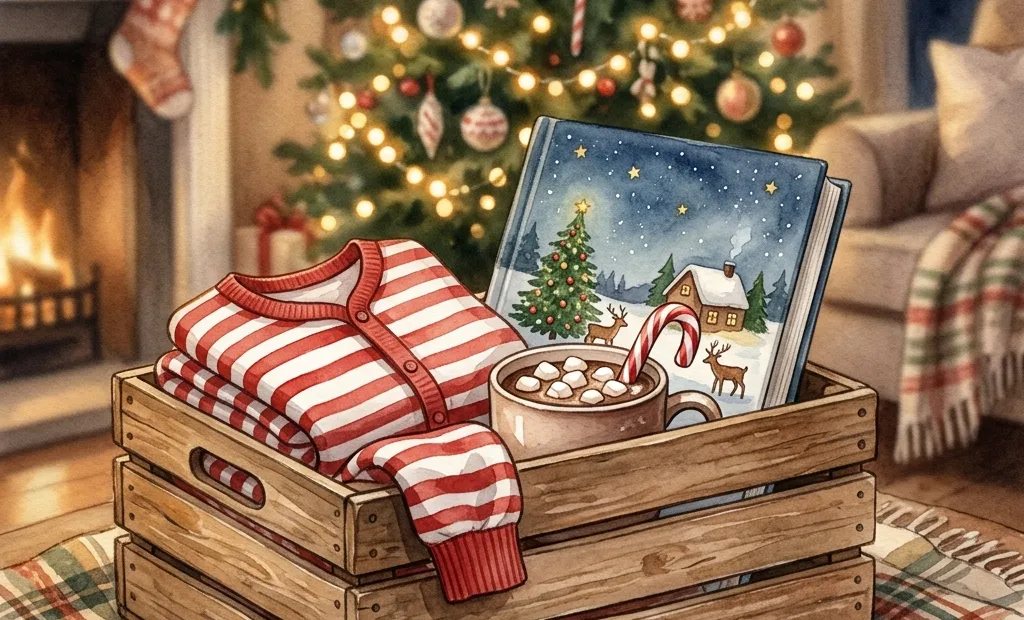
Christmas Eve boxes have become their own subgenre of gift-giving, and somewhere along the way they turned into eight small items instead of one good one. A typical box: matching pajamas, a mug, hot cocoa packets, a movie, a stuffed animal, a bag of candy, a pair of dollar-store slippers, maybe a small toy that will be forgotten by New Year’s.
The instinct behind the box is right. Give the kids something to open on the 23rd or 24th, no wrapping paper drama, everyone excited before bed. But most boxes solve “excitement” with volume, and volume is exactly what makes half of it landfill by January. Eight cheap things get eight seconds of attention each. One good thing gets remembered.
An anchor, and a small supporting cast
The box needs one thing worth building the whole evening around, and two or three items that serve that thing rather than compete with it.
The anchor is the book. Something read aloud, together, as the actual event of the evening — not a side activity while a movie plays in the background. If the book stars the child, this does double duty: it is the anchor for tonight, and it can become the first entry in a running Christmas Eve tradition → if you decide to keep doing this every year.
The supporting cast exists to support the reading, not to compete with the evening’s attention. Pajamas worn while it’s read. Cocoa drunk while it’s read. Maybe one ornament hung on the tree right before bed. Everything in the box should serve the single hour between dinner and lights-out, not the whole month of December.
What to put in the box, by age
Ages 2–4
Short attention spans, sensory focus, an early bedtime that is non-negotiable. The anchor: a short book read aloud in a lap, not handed over to be looked at alone. Supporting cast: soft pajamas, warm milk or a kid-safe cocoa cup, one soft item to hold during the reading. Skip: anything with small parts — a choking hazard on a night everyone is exhausted is a real risk, not a hypothetical one — and skip anything that needs assembly.
Ages 5–7
The sweet spot for a book that stars the child — old enough to sit through the whole thing and genuinely recognize themselves on every page, young enough that seeing it is still magic rather than examined for flaws. The anchor: the personalized book, read together. Supporting cast: pajamas, cocoa, maybe one small dated ornament for “this year.” Skip: a movie in the box — it competes directly with reading time instead of extending it, and on a night this short, something has to lose.
Ages 8–10
This is the age where skepticism shows up, sometimes performed for a younger sibling’s benefit more than genuinely felt. The anchor can shift with them: if you’re running a yearly tradition, let them help choose this year’s book — but a personalized storybook still lands here more often than people expect, because seeing yourself illustrated as the hero of a story does not stop working just because a kid claims to be “too old for picture books.” Supporting cast: cozier pajamas they will actually want to wear, a “big kid” mug, a card game to play together after the reading instead of screen time alone. Skip: stuffed animals, which read as babyish at this age and usually go straight to a closet.
What to leave out entirely
Candy and sugar. Bedtime plus a sugar rush is a bad combination for everyone in the house, including the adults who have to deal with the aftermath.
Dollar-store toys. Cheap plastic that breaks within the week and gets thrown out within the month — exactly the volume-over-substance problem this whole approach is trying to avoid.
Anything “batteries not included.” Christmas Eve is not the night to discover you’re missing three AAs.
Anything requiring assembly or supervision. Parents are already stretched on this particular evening. Do not add a task.
A movie. It is not a bad gift on its own — it is a bad addition to this specific box, because it pulls attention away from the one thing the box is supposed to be building toward.
Reuse the box itself
Buy or make one sturdy box, label it, and bring the same one out every December 23rd or 24th, refilled. It empties every year and reappears every year, and the container itself becomes part of the tradition, the same way a shelf of dated books becomes a tradition in its own right. Kids as young as four start recognizing “the Christmas Eve box” as an object with its own history, separate from whatever is inside it that particular year.
The anchor, in specifics
Akoni Books makes a 16-page personalized storybook in which the child is the illustrated hero, generated from a single photo of them and woven through the story and every page — not a name printed onto someone else’s book. Nine art styles, and every kind of family represented in the theme library.
The dedication page can be signed by whoever is giving the box. During creation there is a field marked “Who’s this book from?”, and whatever you type there prints on the first page — in the digital edition, the printed edition and the free preview:
For Amara, Christmas Eve 2026.
From Mom and Dad.
Every order also includes a 19-page printable Hero Pack — coloring pages, bookmarks, a bedtime audio version of the story — which is worth mentioning here specifically, since the audio version means the same book can go back into rotation on ordinary nights well after the box itself has been put away for the year.
What it costs: digital from $9.99, hardcover $39.99. A free preview shows the cover, the dedication and the opening pages before you pay anything. If the child does not light up at the cover, a full refund — and they keep the book either way.
How long it takes: minutes for the digital edition, so the anchor can be ready the same night you decide to build the box. A printed copy needs more lead time — see the 2026 order-by dates → if you want it in hand before the 24th.
The box is not the point
None of this is really about the box. It is about giving one evening in December a shape that does not depend on how many presents are in it — a shape that would work in a house with one gift or twenty. Fill the box with one thing worth reading and two or three things that make the reading comfortable, and the box has already done its job before anyone opens the last present tomorrow.
Related reading
- Heirloom gift ideas: start a Christmas Eve book tradition →
- What to write in a child’s Christmas book: 20 inscriptions →
- Personalized Christmas gifts: 2026 order-by dates →
Build the anchor first, then fill in the rest of the box around it. Start the book, free to preview →