Heirloom Gift Ideas: Start a Christmas Eve Book Tradition
An heirloom isn't bought once — it's repeated until it has history in it. How to start a Christmas Eve book tradition, and keep it going past age nine.
Every gift guide in December has a section called something like “heirloom gifts,” and it is usually a list of expensive objects — a monogrammed something, a piece of jewelry, a leather-bound thing. None of it is actually an heirloom yet. It is just expensive.
An heirloom is an object that gets used, on purpose, by more than one person across time, and the value is almost entirely in the repetition — not in the object itself. You cannot buy that in one transaction, no matter what the listing promises.
What you can buy is the first entry in something that becomes an heirloom, if you keep doing it.
An heirloom is accumulated, not purchased
Think about the ornament box that actually matters in a family — not the expensive glass one bought as a display piece, but the shoebox with fifteen years of dollar-store and school-craft ornaments in it, each one dated on the bottom in marker. The shoebox is worth more than the glass one, and it cost about four dollars a year to build.
That is the whole mechanism of an heirloom: not price, repetition. An object present at the same moment every year, touched by the same hands, until the history is inside it rather than just attached to it.
Which changes what you are actually shopping for. You are not looking for one perfect object. You are starting a ritual, and picking a shape for it to take.
The Christmas Eve book, mechanically
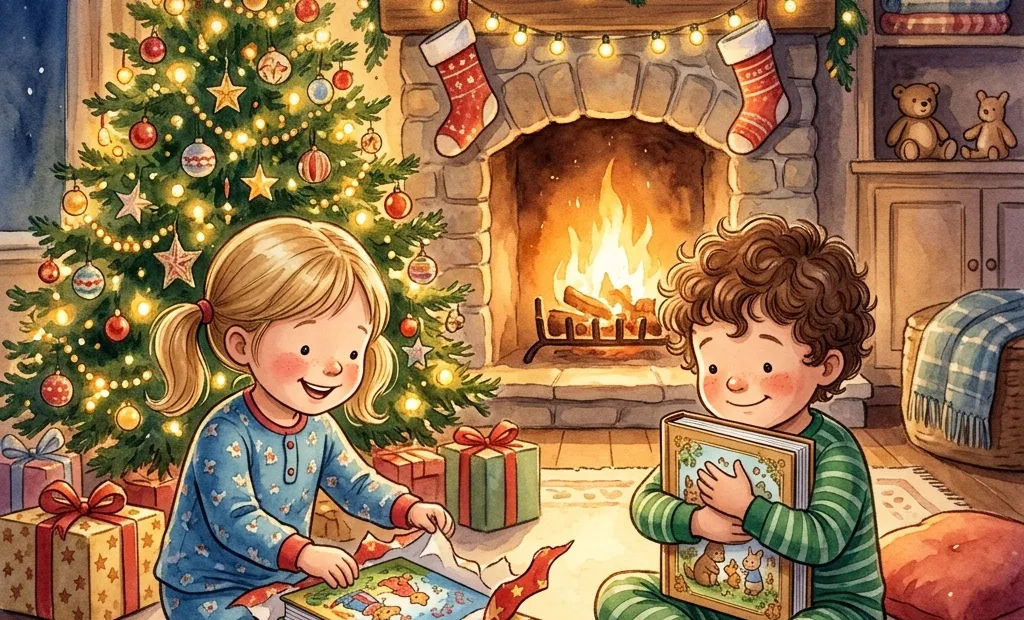
The version of this that works is simple on purpose: on Christmas Eve, every year, one book gets unwrapped and read aloud — not saved for morning, not one of several presents, the specific evening event. After the reading, whoever gave it writes the year inside the front cover, in pen. The book then goes onto a shelf that holds nothing else.
That is the entire tradition. It needs no theme, no matching set, and no planning beyond remembering to do it again next December.
By the time a child is ten, there are eight or nine books on that shelf, each one dated, each one tied to a specific night and a specific age. The shelf is the heirloom. No single book on it is — it is the run of them, in order, that a twenty-five-year-old will eventually pull down and read in one sitting.
Starting it at any age
Some families start this the December after a baby is born. Most do not think of it until the kid is already five, seven, nine — school has started, the years feel like they are moving faster, and the idea arrives late.
Both are fine. Start this year. Write this year’s date inside the cover, and do not try to manufacture the years you missed with a set of “starter” books dated retroactively. A shorter shelf that began honestly beats a longer one that began with a lie in the handwriting. Nobody who inherits this shelf at twenty-five is going to mind that it starts at seven instead of zero.
Keeping it going when they are nine and unimpressed
There is a predictable slump, usually somewhere around eight to ten, where a kid announces they are “too old for picture books” — often performed for a sibling’s benefit more than genuinely felt. This is the point where most families quietly let the tradition die, which is exactly the wrong response, because the tradition was never really about picture books.
Do not argue about the book. Change the book, and keep the ritual. Let them pick what gets unwrapped that year — a chapter book, a graphic novel, whatever they are actually reading at nine. What has to stay fixed is the rest of it: read together on the same night, write the date inside the cover, put it on the same shelf. The signing and the shelf are the tradition. The genre was always going to have to grow up.
Why the personalized book is the right one to start with
Year one is the hardest book to choose, because a newborn or a toddler has no reading preferences yet for anyone to honor. That is exactly why a book built around them specifically is the right way to open the shelf: it cannot be the wrong genre, because it was never really a genre choice. It is a record of exactly who they were and what they looked like the December it was given.
That is also what makes it un-outgrowable in a way an ordinary storybook is not. A generic picture book eventually gets shelved because a nine-year-old feels babyish reading it. A book with their own face on the cover and a date inside it does not compete with what they are currently into — it sits on the shelf as the origin entry, the same way a baby photo does not become embarrassing the way a bad haircut photo from three years ago does.
The book we would start the shelf with, honestly
This is the part where we tell you what we make and let you judge it by the same standard as everything above.
Akoni Books makes a 16-page personalized storybook in which the child is the hero — their real name and their real face, generated from a photo you upload, woven through the story and drawn into every single illustration. Not a name printed onto page three of somebody else’s book. Nine art styles, and every kind of family represented in the theme library.
For this specific tradition, the part that matters most is the dedication page. During creation there is a field marked “Who’s this book from?”, and whatever you type there prints on the very first page — in the digital edition, the printed edition, and the free preview, so you can check it before paying for anything:
For Amara, Christmas Eve 2026.
From Mom and Dad.
That means the date is typed in, not just handwritten — it survives even in the years nobody remembers to bring a pen to the couch. Printed copies also carry a blank bookplate page if you want to add something longer by hand, which is the right place for a longer note in the years you have more to say.
Every order also includes a 19-page printable Hero Pack — coloring pages, bookmarks, a bedtime audio version of the story — which matters less on Christmas Eve itself and more in the eleven months between one Christmas Eve and the next, since a book only earns its place on the shelf if it actually gets read in the meantime.
What it costs: digital from $9.99, hardcover $39.99. Bilingual editions are available for families reading the story in two languages at once, printed together in the same book.
Before you pay: a free preview shows the illustrated cover, the signed dedication, and the opening pages, so you can see whether the likeness lands before spending anything. If your child does not light up at the cover, it is a full refund — and they keep the book either way.
Other heirloom traditions worth running alongside this one
The book does not have to be the only thing on the shelf. A few others are worth doing in parallel, and none of them compete with it.
An ornament, one new one every year. Cheap, small, dated on the bottom in marker. The tree becomes a timeline instead of a decoration by the time there are a dozen of them.
A letter, written on every birthday, opened at eighteen. Slower and more private than the book — nobody reads these along the way, which is exactly what makes the eighteenth birthday land the way it does.
A height mark on a doorframe, dated. Not really a gift, but the same accumulation logic applies, and if the family ever moves, the last thing photographed before the movers arrive is usually that doorframe.
None of these compete for the same slot as the Christmas Eve book. They are proof that the same trick — pick a ritual, repeat it, date it — works in more than one shape.
Related reading
- What to write in a child’s Christmas book: 20 inscriptions →
- Christmas Eve box ideas: put a personalized storybook at the center →
- Personalized Christmas gifts: 2026 order-by dates →
- Softcover or hardcover: a grandparent’s guide →
The first book on a shelf like this only has to be one thing: honest about the year it was given. Build this year’s, free to preview →