Not-Too-Spooky Halloween Books for Little Kids, Sorted by the Actual Fear
Not an age-graded list. Picture books grouped by the specific thing frightening your child this October — the dark, faces that change, the sudden bang, what is under the bed — plus how to read them so the 31st goes better.
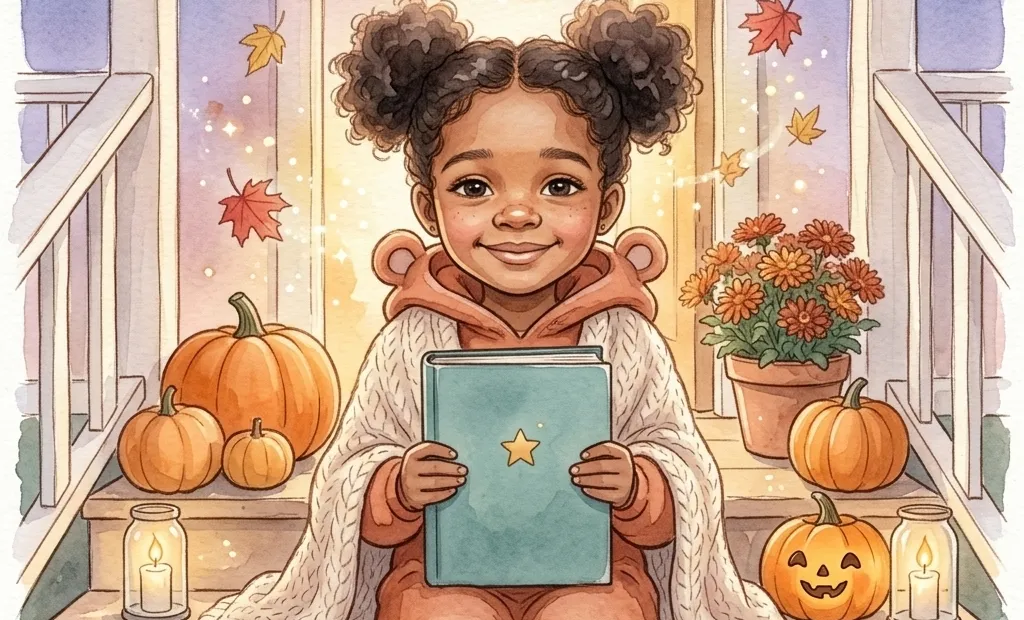
Almost every Halloween book list is organised by age, or by nothing at all — twenty covers with pumpkins on them, in no particular order.
That is not how a small child is frightened. A four-year-old is not afraid of Halloween. They are afraid of one specific thing, usually narrow and quite physical: the hallway light going off, a face that stops being a face, a decoration that lunges as you pass it. The book that helps is the one aimed at that thing. So this list is sorted by the fear — find yours, read that shelf, ignore the rest of the page.
One note first. A picture book is not a conversation about fear; it is practice. Read the right one six or seven times across the last two weeks of October and something shifts. Read it once on the 30th and it is just a story.
If the fear is the dark, or being alone in it
The most common one, and Halloween makes it worse twice over. For two weeks the neighbourhood is decorated in it; then a small child is asked to walk away from their own front door, after bedtime, dressed as somebody else, up a stranger’s path.
The Dark — Lemony Snicket, illustrated by Jon Klassen. Laszlo is afraid of the dark, which lives in the basement. One night it comes upstairs and speaks to him. The boldest book here — it makes the dark a character rather than an absence. Best from about four, and read it in daylight first.
Orion and the Dark — Emma Yarlett. The friendlier version of the same premise: the Dark turns up as a big, cheerful, slightly needy companion and gives Orion a tour of the night. Works from about three.
Can’t You Sleep, Little Bear? — Martin Waddell, illustrated by Barbara Firth. Big Bear fetches bigger and bigger lanterns, none of them enough, until he carries Little Bear outside and shows him the moon. The safest thing to hand a two-year-old.
The Owl Who Was Afraid of the Dark — Jill Tomlinson. A chapter-a-night read-aloud for five and up, in which Plop the barn owl keeps meeting somebody who tells him what the dark is to them. If you have three weeks, this is the one that changes a child’s mind.
If the fear is faces that change
The most underestimated one. Below about four, a mask is not a costume — it is a person becoming something else. Which is why a child can adore the werewolf in the shop and come apart when their uncle puts it on.
Go Away, Big Green Monster! — Ed Emberley. Die-cut pages build a monster’s face feature by feature, then the child sends every feature away again until nothing is left. It hands a child the on–off switch for a scary face. Works from two, and nothing else here does quite what it does.
Glad Monster, Sad Monster — Ed Emberley and Anne Miranda. Comes with monster masks the child holds up to their own face. That is the exercise, not a bonus: putting a face on, taking it off, and still being yourself underneath is exactly what needs rehearsing before somebody knocks on the door in a rubber head.
The Monster at the End of This Book — Jon Stone, illustrated by Michael Smollin. Grover spends the whole book begging you not to turn the page. The monster is Grover. A fifty-year-old joke that still lands, and secretly about dread being worse than the thing.
And a non-book version: before the 31st, let your child put their mask on you, take it off, and put it back, four or five times, with a lot of laughing. Then let them do it in a mirror. Ten minutes of that beats anything here.
If the fear is the bang
Some children are not frightened of monsters at all — they are frightened of being startled. The motion-sensor skeleton, the doorbell, the neighbour who jumps out. What helps is deliberate suspense with a safe landing, so they can practise the rise and fall of a fright with the volume down.
A Dark, Dark Tale — Ruth Brown. A slow walk through a dark dark moor, a dark dark house, a dark dark cupboard. Beautifully built tension; the payoff is a mouse. Children ask for it again immediately, which is the tell.
We’re Going on a Bear Hunt — Michael Rosen, illustrated by Helen Oxenbury. The original controlled fright: slow build, actual bear, run home, family under a duvet. Do it with the noises.
The Little Old Lady Who Was Not Afraid of Anything — Linda Williams, illustrated by Megan Lloyd. She walks home alone in the dark, followed by two clomping shoes, one wiggling waist and a very scary pumpkin head, and is not afraid of any of it. Children adopt her immediately.
Room on the Broom — Julia Donaldson, illustrated by Axel Scheffler. A witch, a cat, an alarming dragon and a rescue by mud monster. The most Halloween-shaped book that is definitively not scary, and the rhyme lets you read fast through the tense bit. (Their Gruffalo works the same way, if you have somehow avoided owning it.)
If the fear arrives at 8pm, after everyone has gone
Sometimes the day is fine and the night is not. What was funny on a doorstep at six is under the bed by eight.
There’s a Nightmare in My Closet — Mercer Mayer. The boy confronts the nightmare, and the nightmare bursts into tears and has to be put to bed. The reversal is the medicine.
Leonardo, the Terrible Monster — Mo Willems. Leonardo is terrible at scaring people and decides to be a wonderful friend instead. Dismantles the entire category.
Big Pumpkin — Erica Silverman, illustrated by S. D. Schindler. A witch grows a pumpkin too big to pull off the vine; a ghost, a vampire and a mummy all fail, and the bat works it out. Takes every classic Halloween figure and makes them useless and a bit silly.
If the question is about skeletons and dying
Around four or five, a child works out that the skeleton on next door’s lawn is a diagram of what is inside them. The question that follows is not a Halloween question and should not get a Halloween answer.
Funnybones — Janet and Allan Ahlberg. Three skeletons leave their dark dark cellar to frighten somebody, fail, and play in the park instead. Defuses the image completely, and it is genuinely funny.
Lifetimes: The Beautiful Way to Explain Death to Children — Bryan Mellonie and Robert Ingpen. If the question turned out to be the real one, this is the plain, calm, non-religious book that answers it.
If your family marks Día de los Muertos — or you would rather your child’s first skeletons were joyful ones than lawn ornaments — our Día de los Muertos list is here. Different holiday, different job, and it does this part far better.
How to read them so they work
In daylight, the first time. Especially The Dark. You want first contact at 11am on a sofa.
Two weeks out, not on the 30th. Six or seven readings is a rehearsal. One is a story.
Let them stop you. If a hand lands on the page, close the book. Shutting a frightening thing on your own terms is a small, real experience of controlling one.
Finish somewhere else. After trick-or-treating, read something with no monsters in it at all — a truck book, a farm book, anything. You are changing the last thing in their head before sleep, which is the highest-leverage two minutes of the night.
Hold three back a year. Relatives buy these in October: Where the Wild Things Are divides small children sharply and you cannot tell in advance which way yours will go; Roald Dahl’s The Witches is genuinely frightening, correctly, and is for eight-plus; and anything with “scary stories” on the cover is for a child who wants to be scared, which is a different child.
Where a book with your child in it fits
Full disclosure, because it should shape how you read this bit: we make personalized children’s books, so we are not a neutral party.
We do make a Halloween book, and it is a bravery book rather than a spooky one. We were slow to build it, because Halloween is a costume-and-candy occasion rather than a gifting one — but the useful half of Halloween is a child being brave in the dark, and that is a thing a book can actually help with.
Every book above uses the same mechanism: it lends your child a character to stand behind — a little bear, a mouse, a barn owl, three cheerful skeletons — and that distance is useful. A child who cannot look at a fear head-on can approach it through Plop the barn owl. A personalized book removes the distance on purpose: your child is the character, and the person who walks into the dark and is fine is them. Borrowed characters are the right first move for most fears — but for the chronically cautious child, seeing themselves be brave is a different kind of evidence.
Akoni’s Halloween Hero 🎃 theme is the one built for this: choosing a costume, walking up the dark path, and being recognised at the door as still themselves underneath. Nothing frightening in it, and the costumes are archetypes — a pumpkin, a sheet ghost, a black cat — never a licensed character. Ages 2 to 10. If you want the bravery without the Halloween setting at all, Great Explorer 🌍 does the same job in caves and forest trails, ages 3 to 10.
Practically: a first name, an age, and one clear front-facing photo. Digital is $9.99 and takes minutes; an 8 × 8 inch softcover is $29.99 and a hardcover $39.99, both arriving in 5–7 business days. Bilingual — English plus Spanish, French, Portuguese or Mandarin Chinese on every page — is $10 more on any format. The illustrations are AI-generated from the photo you upload: stylized artistic renderings in the art style you pick, not photographs and not a human-illustrated commission. You see the cover and opening pages free before paying, and the photo is deleted within 24 hours.
See the Great Explorer preview →
If you are reading this in late October and already thinking a few weeks ahead, the Christmas list is the one with the gifting in it — and print has a real order-by date attached, which Halloween does not.