Who Do You Want to Be This Halloween?
A four-year-old asked what they want to be does not answer with a costume. They answer with a role — and the role is the interesting part. What the answer is telling you, why the outfit comes off after twenty minutes, and how to keep the character going long after October.
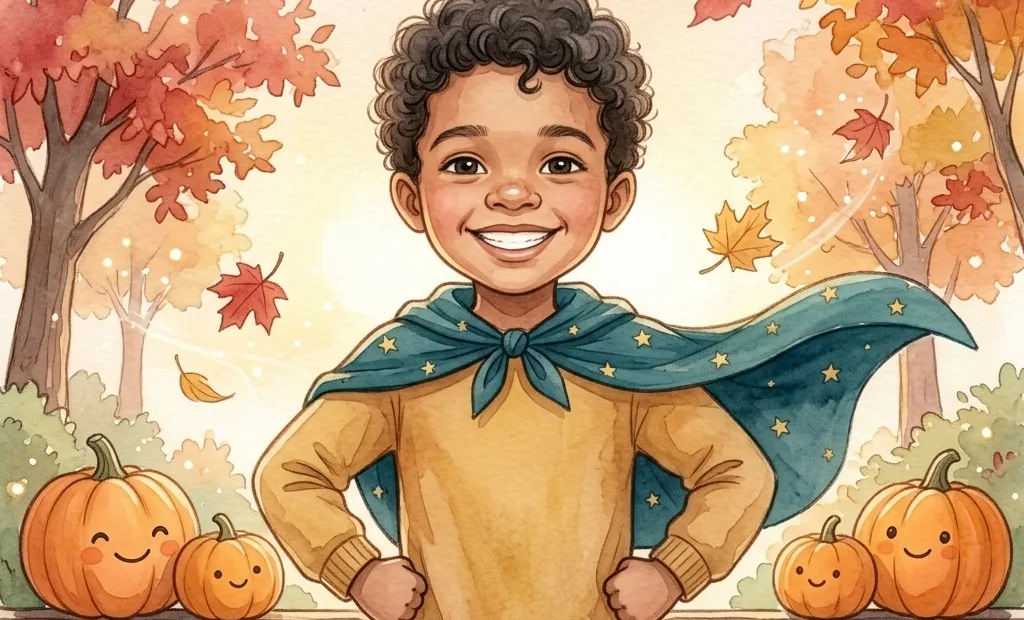
Ask a four-year-old what they want to be for Halloween and you will not get a costume. You will get a role, delivered with total conviction, usually while doing something else.
A vet. A dragon. The postman. An astronaut who is also a cat. They have generally been thinking about it for a while and they are not taking suggestions.
The adult instinct is to convert this into a shopping problem — where do we get the tail, is there a helmet, can we manage it by Thursday. Fair enough: Halloween arrives on a fixed date and the tail has to come from somewhere. But the answer is more interesting than the outfit, and worth five minutes before the logistics take over. Your child has just told you who they would like to be, out loud and unprompted. They will not do that again for months.
The question is not about clothes
Notice the grammar of it. Nobody asks a child what they want to wear for Halloween. Everybody, without deciding to, asks what they want to be.
Children answer the question as asked. A three-year-old in a lion costume is not wearing a lion; for the duration, they are fairly seriously a lion, and they will be annoyed if you address them by name. The costume is a prop supporting a claim about identity, and the claim is doing the work.
This is also why the shop-bought version of their idea sometimes goes down badly. If your child says “a knight” and you produce an excellent knight costume and they refuse it, the usual reason is not the costume. It is that their knight had a specific job — guarding something, finding something, being the one who is not afraid — and the outfit does not know about the job.
Roughly four kinds of answer
A rule of thumb from watching it happen, not a taxonomy out of a journal. But the answers do tend to sort into four piles, each asking for something slightly different.
The big frightening thing. Dragon, T. rex, wolf, shark, monster. Very often chosen by the child who is most easily frightened, which surprises parents every year. Becoming the scary thing is the oldest move available for handling being scared of it, and a child who spends October as a dinosaur has usually been thinking about teeth.
The one with a job. Astronaut, vet, doctor, chef, firefighter, builder, farmer. A competence answer rather than a fear answer: the child has spotted a grown-up who is unambiguously good at something and decided to try the feeling on. These roles survive longest past October, because the job is real and can be practised.
The animal. Cat, fox, bunny, owl, bear. Sometimes a specific animal love, sometimes about being small and soft and permitted to hide. Either way, the cosiest choice and the one that gets worn most.
The exact character from the exact programme. Correct down to the shade of the boots. Partly social — a way of saying I am with those people to a room that will recognise it instantly — and worth taking as seriously as the others, even when it is the fourth Spider-Man on the street.
Pretending is not idle, and there is some evidence for that
Vygotsky’s line about play is the one that gets quoted, and it earns the repetition: in play, he wrote, a child behaves as though “a head taller than himself.” The child in the cape is briefly operating above their own ceiling.
There is also a modern experimental version. Rachel White and Stephanie Carlson, writing in Developmental Science, studied young children doing a task that required self-control. Some were prompted to think about themselves in the first person; others took on a competent character — Batman among them, which is why it is usually called the Batman effect — sometimes with a costume prop to help. The children working as the character did better.
Two honest caveats: that is a laboratory task, not a claim about trick-or-treating, and one line of research is not a law of nature. But it is a reason to think the dressing-up is not merely decorative — taking on somebody else’s competence appears to make a small amount of it available.
Which is a formal way of saying what every parent has already seen. The child who will not put their face in the water will put a shark’s face in the water.
The costume will come off after twenty minutes
It nearly always does — usually the hood first, then the tail, then the whole thing carried by an adult while the child, still entirely in character, runs ahead.
This is not failure and it is not ingratitude. The costume was scaffolding. Once everyone has agreed that this is a lion, the lion no longer requires the ears.
The practical consequence is worth acting on: do not spend the money on the garment. Spend it, if at all, on things that keep the role going, because the role is what your child was asking for. The most-remembered costume in most families is a bedsheet and some determination; the expensive one is in a bag in the loft.
Five things that outlast October 31
Ask “who”, not “what”. “Who are you today?” is a better morning question than any toy. It costs nothing and it gets startlingly detailed answers.
Keep one open box. A cape, a hat, a scarf, some goggles, a torch, a bag. Not a costume — components. Fixed costumes have one setting; components get recombined for two years.
Give the role a problem. This is the big one. A costume with no plot is a garment. Children do not want to be a vet; they want a poorly dog to arrive. Ten seconds of set-up from an adult — “there’s an emergency at the farm” — turns twenty minutes of trailing about into an afternoon.
Take one good photograph, on the day, in daylight. Front-facing, no shadow across the face, before the costume comes apart. You will want it, and it is useful in ways you cannot predict in October.
Put the role in a book. A child who is a knight in the garden and then reads about a knight at bedtime is getting the same idea twice in two forms, which is exactly how five-year-olds decide a thing is real.
Where a book with your child in it fits
Full disclosure: we make personalized children’s books, in which one child is the illustrated hero of an original story built around them. So take this section knowing that.
We now make a Halloween book, and it is built around exactly this question. We were slow to it, for a reason worth keeping: Halloween is a candy-and-costume occasion rather than a gifting one, so a made-to-order keepsake has no obvious slot in it. What changed our mind is that the durable half of Halloween is not the candy — it is a child deciding who they want to be and then being brave in the dark as that person.
But “who do you want to be” is a question we happen to be built around, because a personalized book already does the thing the costume is doing: it casts your child in the role, by name and by face, for sixteen illustrated pages, with a plot attached. It is the same imaginative move with the plot problem solved.
Three of the four kinds of answer have a theme that fits them — plus Halloween itself:
- The big frightening thing → Dinosaur Adventure 🦖 — a kind dinosaur companion, real dinosaur names, low stakes, never scary. Ages 2 to 8.
- The one with a job → Space Voyage 🚀 — a rocket cockpit, a nebula, a friendly alien planet. The astronaut answer, taken literally. Ages 4 to 10.
- The animal → Animal Friends 🐶 — a wildlife sanctuary, a forest meadow, an ocean shore, a jungle, and animals the child befriends. Ages 2 to 8.
- Halloween itself → Halloween Hero 🎃 — choosing the costume, becoming it, walking up the dark path, and being recognised at the door as still exactly themselves underneath. Costumes are archetypes — a pumpkin, a sheet ghost, a black cat, a small dinosaur — never a licensed character. Ages 2 to 10.
- Or, for the child who just wants to be the one who goes first → Great Explorer 🌍 — hidden caves, mountain trails, ancient ruins, a mysterious island. Ages 3 to 10.
The fourth kind — the exact character from the exact programme — we cannot do, and would not try to. That child wants Spider-Man, and Spider-Man is not ours to hand out. What we can offer is a story where the hero is unmistakably them, which is a different pleasure rather than a substitute for that one.
Halloween Hero, Great Explorer, Animal Friends and Space Voyage are pre-built, so they finish in minutes. Dinosaur Adventure is written fresh for your child, which takes 4 to 6 minutes.
Practicalities. You need a first name, an age, and one clear front-facing photo — the one from the doorstep on the 31st works well, which is the honest reason that tip is on the list above. Digital is $9.99. An 8 × 8 inch softcover is $29.99 and a hardcover is $39.99, both including the digital PDF and arriving in 5–7 business days. A bilingual edition — English plus Spanish, French, Portuguese or Mandarin Chinese on every page — is $10 more on any format. One child stars per book; a second child means a second book, which is a real constraint and worth knowing before checkout.
How the pictures are made: they are AI-generated, using your photo as a visual reference. They are stylized artistic renderings in whichever of the nine art styles you choose — not photographs, and not a human-illustrated commission. You see the cover and the opening pages free before paying, so you judge the likeness yourself first. The photo is deleted within 24 hours and is never used to train AI models. If the child does not light up when they see themselves in it, email within 30 days of delivery and we refund in full — and they keep the book.
See what it looks like for your child →
One last thing
The costume goes in a bag on November 1st. The question does not have to.
Ask it again in January, when there is nothing at stake and nothing to buy — who do you want to be today? You will get a completely different answer, delivered with the same conviction, and that is the actual point of the whole exercise. Halloween is just the one day a year when everybody remembers to ask.
Related reading
- Not-too-spooky Halloween books for little kids, sorted by the actual fear →
- Why personalized books build confidence →
- 9 art styles for a children’s storybook →
- How to make bedtime reading magical →
- Answer: can I get a book where my child is the hero? →
- 9 Christmas gifts for grandkids that aren’t toys →