A Personalized Story for Kids Scared of the Dark (Where They're the Brave One)
Why the dark is scary at 2–6, what actually helps at bedtime, and a personalized story where your child comforts a monster and becomes the brave one.
“There’s something in my closet.” “I don’t like it when the door is all the way closed.” “Can you stay until I fall asleep?” If you’re hearing some version of this most nights from a two- to six-year-old, you are not doing anything wrong, and your child is not being difficult. You have a kid at exactly the age when being scared of the dark is completely normal.
October makes it louder, not because Halloween invents the fear but because it turns the volume up on a fear that was already there — a pumpkin grinning off a neighbor’s porch is just circumstantial evidence for a case the dark has been building all year. So this is a bedtime post first and a Halloween post second. The strategies below work in March. The seasonal part is just a nudge, saved for the end.
Why kids get scared of the dark
A three-year-old isn’t overreacting to the dark. Given what’s actually happening in their head at that age, it’s a reasonable thing to be uneasy about.
Two developmental things are colliding. First, imagination is racing ahead of reasoning — a child this age can vividly picture a monster under the bed but doesn’t yet have a reliable logical tool to rule it out (“monsters aren’t real” is a fact they can repeat back to you without it actually landing as certainty at 9pm). Second, darkness removes the one thing toddlers rely on most to feel safe: seeing that the room is the same room it was five minutes ago. Take away the visual confirmation and the imagination fills in the blank — and it rarely fills it in with something boring.
This is also, not coincidentally, the age when a lot of kids start asking to be a “brave” costume for Halloween — a dragon, a knight, a superhero. Becoming the powerful thing is one of the oldest tricks for managing a fear of it, just pointed a different direction depending on the month.
None of this is a phase to be embarrassed about or a discipline problem to fix. It’s a normal, temporary side effect of a brain developing imagination faster than it’s developing the tools to manage it.
What actually helps
None of this makes the fear vanish overnight, and it isn’t a substitute for talking to your pediatrician if the fear is severe or the sleep loss is serious. But a few small, repeatable things tend to help:
Name it instead of arguing with it. “Tell me what it looks like” gets you further than “there’s no such thing.” A fear you can describe out loud is a fear you can do something about together — check the closet, look under the bed, turn the fear into a two-person investigation instead of a solo dread.
Keep the bedtime routine identical, every single night. Consistency is a bigger lever than any individual trick. A predictable sequence — bath, pajamas, book, lights dim, one song, goodnight — tells a child’s nervous system that nothing surprising is coming, which does more to settle a nervous kid than any pep talk. We’ve written a longer piece on building that ritual if bedtime has gotten chaotic in your house.
Let a nightlight be enough, without negotiating it down. Total darkness is not a badge of honor for a four-year-old. A warm, dim light that lets them confirm the room hasn’t changed usually solves more of the problem than any amount of reassurance does.
Read the fear, don’t just talk about it. A picture book gives a child a character to stand behind — someone who was scared of the same thing and did something about it. Watching someone else be brave first, on a page, in a safe and repeatable ten minutes, is genuinely different from a parent saying “don’t worry” from the doorway.
Borrow the “be brave” trick, on purpose. There’s a real psychological effect behind why kids act more capable when they’re pretending to be someone confident — it’s why a child who won’t put their face in the pool will do it as a shark. We go deeper into the research behind that one here. The short version for bedtime: a child who is “being” the brave character in a story has an easier time being a little braver themselves, ten minutes later, in the actual dark hallway.
The reversal that works especially well: a monster who’s scared too
Here’s a trick that shows up in a lot of good kids’ books about fear, and it’s worth trying even without buying anything: flip the fear around. Instead of your child being the small one facing something big and scary, what if the “scary” thing turns out to be smaller and more frightened than they are?
It’s the engine behind every story where the monster turns out to be the anxious one — and it works because it changes your child’s job. They stop being the one who needs rescuing and become the one doing the rescuing. That’s a much easier role to feel confident in at bedtime, and it’s true to how most kids actually resolve this fear: not by being told the dark is empty, but by deciding, on their own terms, that they’re capable of handling it.
Where Akoni’s Monster Buddy fits
This is the part where we tell you plainly that we make personalized children’s books, so take the rest of this section knowing that.
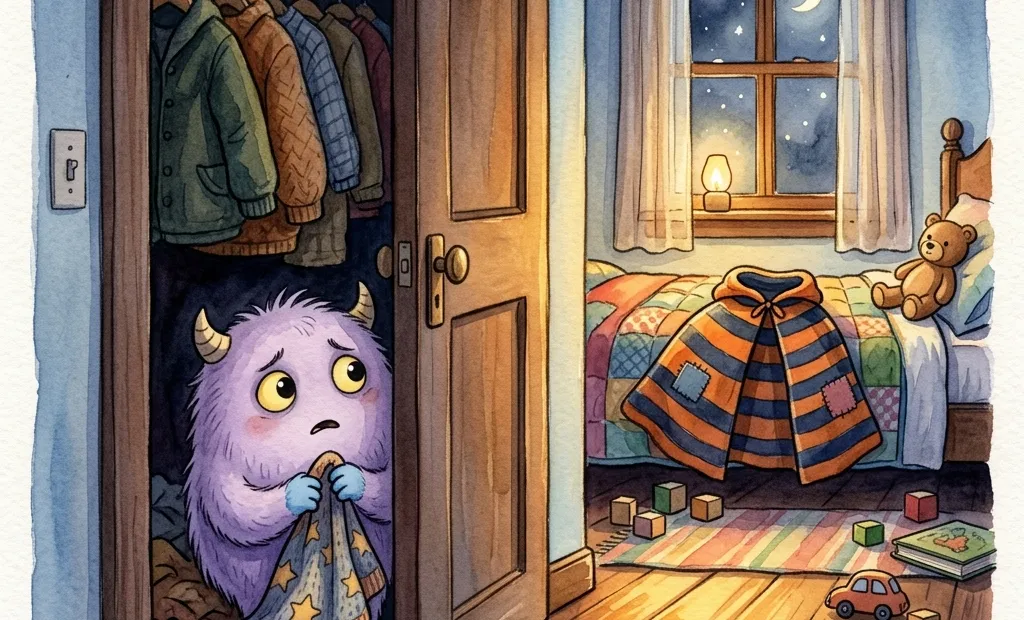
Akoni’s Monster Buddy theme is built around exactly the reversal above. In it, your child is the illustrated hero of a story where a small, fluffy, lilac-colored monster is shaking in the back of the wardrobe — scared of the dark, exactly the way a lot of kids are. Your child doesn’t run. They tie on a blanket cape and become the brave one, and by morning, neither of them is scared anymore. It’s friendly-spooky, not scary — nothing in it is designed to give a child a new fear on the way to solving an old one — and it’s a year-round bedtime book, not a once-a-year costume story. Ages 2 to 6.
The mechanics are the same as any Akoni book: you upload one clear front-facing photo, and your child becomes the illustrated hero of the whole story, with their real name and their own face on every page — not a stranger’s kid in a Halloween-adjacent story. The illustrations are AI-generated, styled as artistic renderings based on that photo, not a photograph and not a human-drawn commission, and you see the cover and opening pages in a free preview before paying anything, so you can judge the likeness yourself first. The photo itself is deleted within 24 hours.
What it costs: $9.99 for the digital edition, ready in minutes; $29.99 for an 8×8” softcover or $39.99 for a hardcover, both with shipping included and arriving in 5–7 business days in the US. A bilingual edition — English alongside Spanish, French, Portuguese or Chinese, printed on every page — is $10 more on any format. If your child doesn’t light up when they see themselves on the cover, we’ll refund you in full, and you keep the book either way.
See Monster Buddy for your child →
The Halloween timing, briefly
Since this fear peaks right when the decorations go up: if you want a printed copy in hand by Halloween, order print by Friday, October 16 — about two weeks out is the safe margin for US shipping. Digital is ready in minutes, so it’s still an option right up to October 31st itself.
Monster Buddy isn’t a costume story, so it works exactly the same in March as it does in October — no seasonal expiration date. If what your child actually wants this year is the costume-and-doorstep version of bravery instead, we’ve built four separate Halloween stories for exactly that, from a first costume for a toddler to a knight who walks the littlest ghost home. See all four on the Halloween page →
FAQ
Is Monster Buddy actually scary? No. The monster is small, fluffy, and scared — not menacing — and the whole point of the story is that nothing in it turns out to be frightening once your child looks at it directly. There’s nothing here designed to startle a young reader.
What age is this really for? Built for 2 to 6, which is squarely the range where fear of the dark is most common and most manageable with a story like this.
Can I preview it before paying? Yes — the free preview shows the illustrated cover and opening pages with your child’s actual name and face before you spend anything.
Does this replace talking to my child about their fear? No, and it isn’t meant to. It’s a tool alongside the basics — a consistent routine, a nightlight, naming the fear out loud — not a substitute for any of them.
Is this only useful around Halloween? No — that’s the whole point. Fear of the dark isn’t seasonal, so this is written and priced as a bedtime book, not a holiday one. Halloween is just when a lot of parents happen to go looking for it.