The Post-Halloween Blues Are Real — Make Your Child the Hero of Their Own Storybook
November 1st is harder than October 31st for a lot of kids. Why the day after hits so hard, and how to give the character they became somewhere to live on.
A kindergarten teacher in Oklahoma posted something last year that every parent and every teacher recognized instantly: on November 1st, she said, “the expectations are low.” Twelve years of teaching taught her that the day after Halloween is not a normal school day. Some kids are sick. Some fall asleep at their desks. All of them are somewhere between a sugar crash and a costume hangover, and nobody is getting long division out of that room.
It went viral for the obvious reason — it is true, and almost nobody says it out loud before the fact. Everyone plans for October 31st. Nobody plans for November 1st.
Why the day after hits harder than the day of
Part of it is chemistry. The “sugar rush” itself is mostly folklore, but the crash that follows a night of trick-or-treating is not — a sudden dip in blood sugar affects both energy and mood, and a nine o’clock bedtime that actually happened at eleven makes it worse. Add a full evening of noise, sprinting, and low-grade fear-and-thrill, and you get a child whose nervous system is simply overdrawn. That part is real, it is temporary, and a slow breakfast and a quiet morning mostly fixes it.
But there is a second thing going on underneath the sugar, and it is the more interesting one.
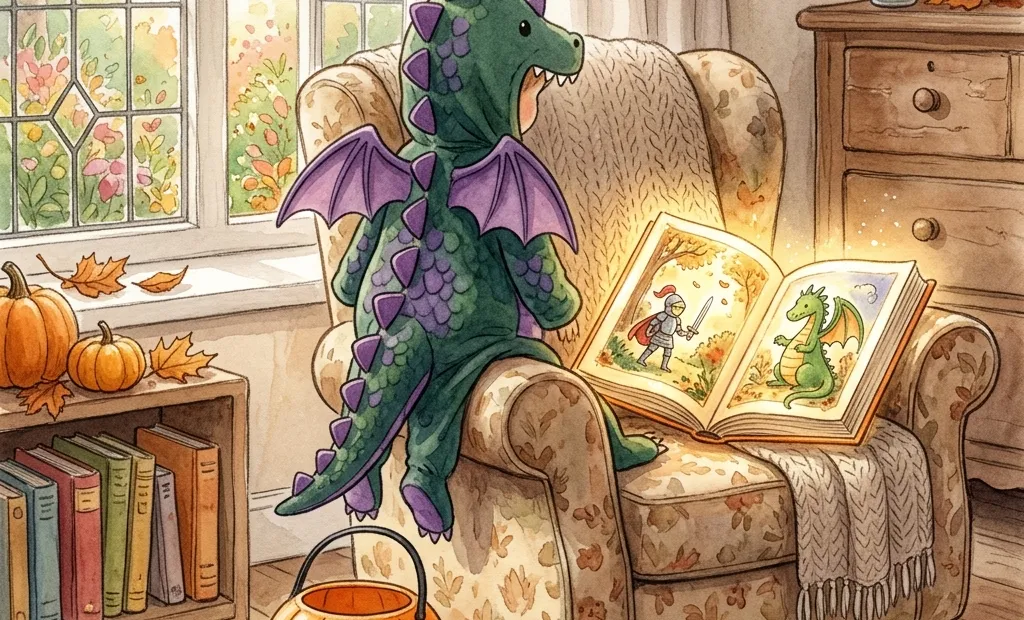
For about six weeks, your child has been building up to becoming somebody. Choosing the costume was the easy part — the actual work was weeks of being, in their own head, a dragon, or a vet, or a very specific dinosaur. Then one evening happens, and it is genuinely thrilling, and it ends. By eight-thirty the costume is on the floor and the candy is being sorted into piles, and by the next morning the whole elaborate identity is simply over. No other holiday does this to a child quite as sharply. Christmas has a tree that stays up, presents that get played with for weeks, a school break to unwind in. Halloween has one night, and then a compost bin.
That is a real letdown, and it deserves to be named as one instead of filed under “overtired.” A child who is weepy or clingy or strangely flat on November 1st is not only sugar-crashed. Some of it is closer to what an adult feels the day after a trip ends — the specific comedown of a good thing having a hard stop.
What actually helps on November 1st
Lower the bar on purpose, the way that teacher does. If Halloween landed on a school night, this is not the day for a spelling test or a big ask. A slow morning, a normal breakfast instead of leftover candy, and permission to be a little useless for a few hours will get you further than any amount of cheering up.
Let the costume stay half-real for a few more days. You don’t have to bag it up on November 1st. A cape worn over pajamas, ears kept on the dresser, a mask allowed at breakfast on a Saturday — a soft landing costs nothing and it tells your child the character doesn’t have to end on a deadline you set.
Sort the candy together, slowly. The sorting-into-piles ritual (trades, favorites, a “save for later” jar) is not just crowd control. It gives the evening a second act, which is exactly what’s missing once the actual trick-or-treating is over.
Take the photo before the costume gets washed or returned. Not the blurry doorstep one — a real one, front-facing, in daylight if you can manage it the next morning. You’ll want it for reasons that have nothing to do with Halloween, which is the next section.
Give the character somewhere to keep living
Full disclosure before this part: we make personalized children’s books, so we are not a neutral party here — read it knowing that.
Here is the actual problem with Halloween, stated plainly: your child spent weeks becoming a character, and then the character had exactly one evening to exist. A personalized storybook is, structurally, a way of fixing that. It takes the same move Halloween makes — casting your child as someone, by face and by name — and gives it sixteen pages and a plot instead of one dark walk around the block.
Akoni Books turns one photo of your child into the illustrated hero of an original story, written for their name, age, and the theme you pick. If the costume was a dragon or a dinosaur, Dinosaur Adventure 🦖 gives that same energy a real story instead of a single night. If it was an astronaut, a vet, or “the one with a job,” Space Voyage 🚀 or Helper puts them back in that role, doing it properly, on the page. And if what your child actually wants is Halloween itself — the costume, the dark path, the doorstep, being recognized underneath it all — Akoni’s own Halloween Hero 🎃 theme is built around exactly that walk, minus anything genuinely scary. Ages 2 to 10.
Practicalities, since gift guides that skip this part aren’t useful. You need a first name, an age, and one clear front-facing photo — the one you just took on November 1st works fine. If a photo isn’t available, there’s a “choose a character instead” option that skips the upload entirely. Halloween Hero, Space Voyage, Animal Friends and Great Explorer are pre-built templates, so the digital book finishes in minutes; Dinosaur Adventure is written fresh for your child and takes a little longer. Digital is $9.99. An 8×8” softcover is $29.99 and a hardcover is $39.99, both including the digital PDF and shipping free, arriving in 5–7 business days. A bilingual edition — English plus Spanish, French, Portuguese, or Mandarin Chinese on every page — is $10 more on any format.
The illustrations are AI-generated, using the photo as a visual reference — stylized artistic renderings in whichever of the nine art styles you choose, not photographs and not a human-illustrated commission. You see the cover and opening pages free, before paying anything, so you can judge the likeness yourself. The photo is deleted within 24 hours and is never used to train AI models. If it doesn’t land, email within 30 days of delivery for a full refund, and your child keeps the book either way.
The candy runs out. The story doesn’t have to.
By the second week of November, the candy is gone and so is most of the memory of who your child was for that one evening. That is fine — it’s supposed to be temporary, that’s what makes it Halloween. But if you want the version of your child who was brave enough to walk up a dark path in a costume to exist somewhere past November 1st, a book is one of the few things that actually does that job. Not a replacement for the night. Just somewhere for the character to keep living after the costume goes in the bag.
See what it looks like for your child →