A Personalized Book to Practice Trick-or-Treating Before the Big Night
Trick-or-treat nerves are four unrehearsed things: the knock, the words, the wait, the dark bit. How to practice each — and how a book helps.
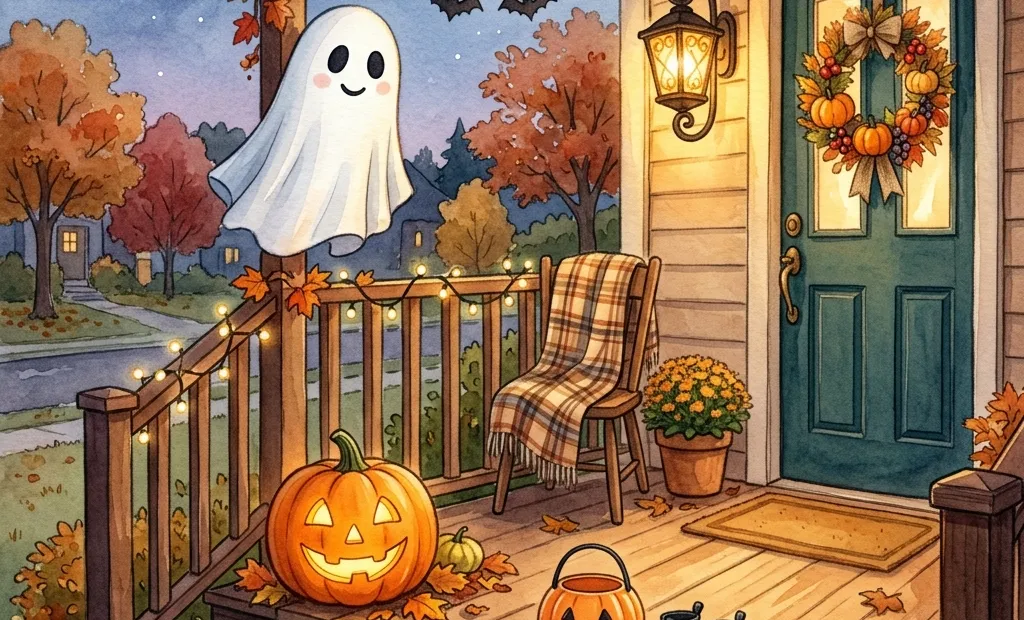
Every year it’s the same small scene on somebody’s front step: trick-or-treat nerves, in the flesh. Costume on, bucket in hand, porch light on and welcoming — and the child stalls three feet from the door. Won’t knock. Won’t say the words. Sometimes won’t go up the path at all, and you end up doing the whole transaction while they hide behind your leg.
This is not a child who dislikes Halloween. It’s a child doing a specific, unfamiliar thing for the first time, in front of an audience, in the dark, wearing something that half-covers their face. Nobody is smooth at that on the first try. The fix isn’t a pep talk on the sidewalk — it’s rehearsal, done earlier, at home, when nothing is actually at stake.
It’s not “Halloween.” It’s four specific unrehearsed moments.
Ask a nervous three- or four-year-old what’s actually wrong and you rarely get “Halloween” as the answer. You get something narrower:
- The knock or the doorbell — a stranger’s door, not their own
- The words — “trick or treat” said out loud, to an adult they don’t know, on command
- The wait — the few seconds of silence after knocking, before the door opens
- The dark bit — the stretch of driveway or path between the sidewalk and the porch light
Every one of those is a small, learnable, physical skill. None of them is really about candy or costumes at all. Which is good news, because skills can be practiced somewhere with no stakes, well before the night it matters — and a child who has knocked, said the line, and stood in the dark for three seconds a dozen times already is a completely different kid on the actual doorstep than one doing all four for the first time at once.
Trick-or-treat nerves: what to actually rehearse in the two weeks before
Practice the knock and the wait, at your own front door. Stand your child outside it, have someone answer from the inside, and make them wait through a real pause before the door opens. The wait is the part nobody thinks to rehearse and it’s often the part that unravels a child mid-transaction.
Practice the exact words, out loud, more than once. “Trick or treat,” then — this is the part that gets skipped — “thank you” on the way out. Say it together in the kitchen a few evenings running until it comes out automatically instead of needing to be summoned from scratch under pressure.
Walk the dark bit, in daylight first, then again at dusk. If there’s a specific stretch of path, driveway, or gap between streetlights that worries them, that’s the one to walk on purpose, hand in hand, before the 31st. A flashlight of their own to carry helps more than almost anything else on this list — it turns “the dark” into a job they have a tool for.
Do one real dry run before the big night, at a grandparent’s porch or a neighbor’s, somewhere warmly lit and low-pressure. Actual practice, not a pretend one — knock, say the words, get a small reward, say thank you, walk away. One good rep at a friendly door is worth a dozen rehearsals in the kitchen.
Read it six times in the last two weeks
Reading counts as rehearsal too, and it’s the rehearsal every family already has a slot for, because bedtime happens whether or not you plan anything else. The trick — the same one behind our sorted-by-fear list of not-too-spooky Halloween books — is that a book only works as practice if you actually repeat it. Read the right one once, on October 30th, and it’s a story. Read it six or seven times across the two weeks before, and the shape of the night — knock, wait, words, dark bit, door, candy, thank you, next house — starts to feel familiar before it’s ever happened for real.
That’s a strong argument for a book that gives a useful ordinary practice sequence rather than one big anxious middle. It’s the same logic behind helping a child through first-day-of-school nerves: turn an unknown into a known before the day arrives, and most of the fear goes with the unknown.
Where a book that stars them changes the rehearsal
A generic Halloween picture book rehearses the sequence with somebody else’s kid doing the brave part. A book where the illustrated hero is unmistakably your child does something slightly different: it rehearses the sequence with them already having done it, successfully, cover to cover, several nights running, before they ever stand on a real porch.
That’s the idea behind Akoni’s Halloween Hero theme, and — because the exact fears change with age — it’s actually two stories (each one prints with your child’s actual first name in place of “{Name}”), and your child’s age is what decides which one they get.
For the pumpkin-costume years, roughly ages 2 to 5, it’s {Name}‘s Halloween: the costume goes on and they stand a little taller, then it’s a brave breath on that first dark doorstep, and a neighbor who recognizes them instantly — “I would know you anywhere” — proof that under the costume they’re still completely, recognizably themselves. That last beat matters more than it looks: a lot of toddler trick-or-treat panic is really a fear of not being seen, and the story rehearses being seen and known anyway.
For the slightly older crowd, roughly 6 to 10, once the pumpkin suit doesn’t fit the mood anymore, it’s The Night {Name} Was a Knight: cardboard armor instead of a costume, going first into the blue dark rather than trailing behind, walking the littlest ghost on the street home when they get scared, and finding that the spookiest-looking porch on the block belongs to the kindest neighbor. Same rehearsal — knock, dark, doorstep, recognition — pitched at a kid who’s ready to be the brave one for somebody younger, not just brave for themselves.
Both are part of a four-story Halloween launch — there’s also a small monster scared of the dark, and a first-spell story about trying again after it goes wrong. See all four →
How it actually works, honestly
Akoni Books makes a personalized storybook where your child is the illustrated hero of every page, generated from one photo. You give a first name, an age (which is what decides {Name}‘s Halloween versus The Night {Name} Was a Knight), and one clear front-facing photo, then pick from nine art styles. There’s an optional line for “Who’s this book from?” that prints as a signed dedication if you fill it in.
You see the illustrated cover and opening pages — a genuine free preview, not the whole book — before paying anything, so you can check the likeness yourself. The photo is deleted within 24 hours and never used to train any model. The illustrations are AI-generated, styled as artistic renderings based on the photo — not photographs, not a human-drawn commission. Every costume is friendly-spooky by design: grinning pumpkins, bedsheet ghosts, paper bats, never a mask hiding your child’s face — which, given the section above, is rather the point.
What it costs: $9.99 for the digital edition, ready in minutes. $29.99 for an 8×8 inch softcover, $39.99 for a hardcover — both with shipping included. A bilingual edition, in English plus Spanish, French, Portuguese, or Mandarin Chinese, is $10 more on any format. And if your child doesn’t light up when they see themselves on the cover, we’ll refund you in full — and you keep the book regardless.
Timing for Halloween 2026
Halloween falls on Saturday, October 31, 2026. Printed books ship in 5–7 business days in the US, so order by Friday, October 16 for time to run the read-it-six-times plan above. Digital has no such deadline — ready in minutes, right up to the night itself.
Quick questions
Will my child still recognize themselves if their real costume covers part of their face? In the book, yes — every illustration keeps your child’s face visible; nothing is drawn as a mask or a hood pulled over the eyes. That’s true even in the story, where a neighbor recognizes the hero specifically because their face is still their own.
Can I choose which costume shows up in the illustrations? Not the specific costume design — {Name}‘s Halloween and The Night {Name} Was a Knight are pre-built, so what happens on each page is fixed. What you do choose is the art style (nine options) and, with the dedication field, who the book is from.
What if this is their very first Halloween, or their first time actually walking up to a door? That’s exactly the age band {Name}‘s Halloween is written for. The whole arc — first costume, first doorstep, first “I’d know you anywhere” — assumes this is new.
Does the book fix a fear of something more specific, like dogs or loud decorations? No, and it’s honest to say so. It rehearses the knock, the words, the wait, and the dark bit of path — not every possible thing on a given street. For a specific, sharper fear, pair it with our list of books sorted by the actual fear.